Estimates vary. Some 2026 price lists put a new tarmac driveway at about £45 to £100 per square metre, others at £60 to £90 per square metre installed. Concrete is generally not cheaper, coming in higher per square metre than tarmac. The cheaper option for your specific property will depend on the exact specification, the size of the area and the condition of the ground underneath. You will always need a local contractor to visit the site and provide a detailed written quote.
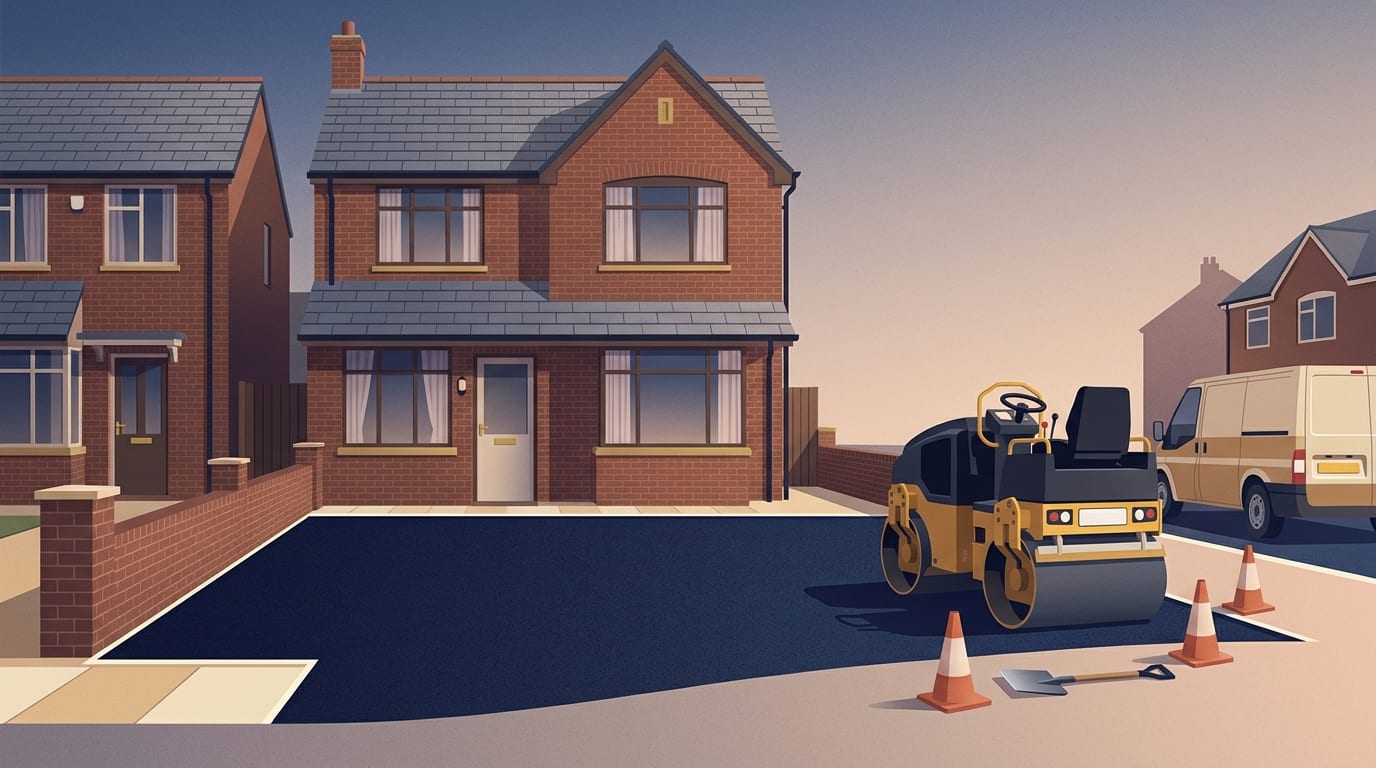
How much a tarmac driveway costs and prices by size
Landscapers price per project after a site visit, so there is no single fixed price for a driveway. The main cost drivers are the area being covered, the extent of the groundwork, the levels of the site, access and the cost of waste removal. Everything carried through the house costs more. Materials also dictate the price, and jobs in London and the South East cost more than elsewhere. Always check whether your quote includes VAT.
This table shows the total estimated costs for a new tarmac driveway by size.
|
Driveway size |
Estimated total cost |
|---|---|
|
30 square metres (one car) |
£1,300 to £3,200 |
|
60 square metres (two to three cars) |
£2,500 to £5,000 |
|
90 square metres (four to six cars) |
£4,000 to £7,500 |
These are typical 2026 guide figures, and your local quotes will differ based on your property and the contractor. If you want a different finish, coloured tarmac adds roughly £10 to £20 per square metre to the total. Larger landscaping jobs are usually paid in stages. If you are considering other materials, you might also want to compare the resin driveway cost before making a final decision.
Is concrete cheaper than tarmac?
Typical 2026 prices put concrete at £85 to £130 per square metre installed, against tarmac at £60 to £90 per square metre installed, so concrete comes in higher per square metre. Labour alone for concrete is typically £33 to £55 per square metre, and the two sets of figures should not be mixed.
This table shows the total estimated costs for a standard concrete driveway by size.
|
Driveway size |
Estimated total cost |
|---|---|
|
30 square metres (one car) |
£2,500 to £4,000 |
|
60 square metres (two to three cars) |
£5,000 to £7,500 |
|
90 square metres (four to six cars) |
£7,500 to £11,000 |
These are typical 2026 guide figures, and your local quotes will differ depending on the site. The tarmac and concrete totals above are compiled differently and differ in what they include, so always check the specific labour and material breakdown on your written quotes.
Understanding hard landscaping and garden terms
A driveway is a major piece of hard landscaping. Hard landscaping is the built part of a garden, which includes patios, paths, walls, steps, decking, fencing and drainage. Soft landscaping is the living part, such as soil, turf, planting and trees. If you are completely overhauling your outdoor space, a garden designer produces the plan, a landscaper or landscape contractor builds it, and a gardener maintains it.
If your driveway is part of a larger garden redesign, you will encounter other specific materials. For decking, quotes should distinguish between softwood, hardwood and composite boards, as well as the frame beneath them.
What goes under a tarmac drive
The groundwork nobody sees is where corners get cut by poor tradespeople. For a new tarmac driveway, the area is typically dug out to about 240mm below the finished level. Digging out to that depth generates waste, so check that waste removal is in the quote.
The contractor will then lay a sub-base, which is compacted crushed stone, often called MOT Type 1. This sub-base is also used under paving and artificial grass to provide a stable foundation.
A good quote states the exact excavation depth, the sub-base depth, named materials, drainage plans and waste removal. One contractor's quote states that a 150mm sub-base, a 50mm base coat and a 30mm top coat is adequate for a residential driveway. This is presented as one contractor's specification, not a universal rule, but it shows the level of detail you should expect in writing.
How long the work takes and how long it lasts
The time it takes to lay a tarmac driveway depends on the size of the area. A 30 square metre drive for one car takes one to two days, while a 60 square metre space for two to three cars takes two to three days. A larger 90 square metre driveway takes three to five days. Complex jobs or poor weather can extend these timeframes to about one week.
Concrete driveways take longer to install and cure. A 30 square metre concrete drive takes two to three days to lay, a 60 square metre drive takes three to five days, and a 90 square metre drive takes five to seven days. Once poured, concrete reaches its full curing strength a minimum of 28 days later. Ask the contractor when vehicles can use the drive.
Concrete driveways can be prone to cracking over time, particularly with ground movement or heavy loads. To manage this, control joints should be spaced 2.4 metres to 3 metres apart, with 4.5 metres as the absolute maximum. No fixed lifespan applies to tarmac, because it depends on the quality of the base, the drainage and how heavily the driveway is used.
Resurfacing an existing tarmac drive
If your current tarmac driveway has a solid base but a worn surface, resurfacing is an option. Resurfacing costs £50 to £70 per square metre. Resurfacing only suits a sound existing base, so ask the contractor to assess it.
Each resurface adds about 30mm to the driveway height. Because of this, the advice is to have no more than two resurfaces over the driveway's life. The extra height can bring the surface close to your home's damp-proof course.
Drainage, planning rules and garden permissions
Tarmac drives repel water extremely well, which makes drainage a vital part of the design. A properly laid driveway must have a fall, which is a slight slope that sheds water away from the house and towards a suitable drainage point.
In England, the Planning Portal states that paving more than five square metres of a front garden with an impermeable surface that does not drain to a permeable area needs planning permission. You do not need planning permission for a new or replacement driveway of any size if you use permeable surfacing, such as porous asphalt, gravel or permeable concrete block paving. You are also exempt if the rainwater is directed to a lawn or border to drain naturally. These permitted development rights apply to houses, not flats or maisonettes. Always ask your contractor if the quoted tarmac is porous, and read more about planning permission for a new driveway if you are unsure.
If your project involves other landscaping, different rules apply. In England, decking is permitted development if it is no more than 30cm above the ground and, together with extensions and outbuildings, covers no more than 50 per cent of the garden. Fences and walls can be up to 1 metre high next to a road or its footpath, and 2 metres elsewhere. Listed buildings need consent for significant work. If you need to remove a tree, check for a Tree Preservation Order, which makes it an offence to cut down, lop, uproot or damage a protected tree without the council's consent. Work on trees in a conservation area normally needs six weeks' notice to the council.
Trade schemes, consumer rights and what goes wrong
Landscaping is not a licensed trade, so vetted membership and evidence of past work matter. The British Association of Landscape Industries (BALI) says its Accredited members are vetted on workmanship, skill and health and safety. The Association of Professional Landscapers (APL) says members are assessed, regularly inspected and TrustMark accredited. TrustMark is the government-endorsed quality scheme. For design work, the Society of Garden and Landscape Designers (SGLD) is the professional body. Membership is a good sign, not a guarantee.
Under the Consumer Rights Act 2015, work must be done with reasonable care and skill. If it is not, the customer can ask for it to be put right or seek a partial or full refund. A quote is a fixed price for the work described, whereas an estimate is a rough guess. Citizens Advice suggests getting three written quotes, having a written contract, paying deposits of no more than 25 per cent and paying by card. You might also be able to cancel within 14 days of agreeing a contract. Any trader who carries waste must be a registered waste carrier, and this register is public.
When corners are cut in landscaping, these are the most common things that go wrong:
- Doorstep callers offering cheap paving or leftover materials from a nearby job.
- Cash deals with no written specification or contract to protect you.
- Thin or missing sub-base that can cause the driveway to sink.
- Slabs laid on dabs of mortar instead of a full bed, leaving them loose and prone to cracking.
- No fall built into the surface, meaning water pools or runs straight towards the house walls.
- Artificial grass laid straight onto soil without a proper compacted stone base.
Common questions
Why do quotes for the same driveway vary so much?
Quotes differ because contractors specify different excavation depths, sub-base thicknesses and materials. One quote might include a full 240mm excavation and registered waste removal, while a cheaper quote might cut corners on the groundwork or leave you to deal with the waste.
Can I use standard tarmac in a front garden?
In England, you can use standard, impermeable tarmac in a front garden without planning permission only if the area is no more than five square metres, or if the surface directs rainwater to a lawn or border to drain naturally. Otherwise, you must use a permeable material like porous asphalt or apply for planning permission.
How soon can I park on a new concrete driveway?
Concrete reaches its full curing strength a minimum of 28 days after pouring, so ask your contractor when you can use the drive and when heavy vehicles are safe on it.
Does a dropped kerb come with a new driveway?
No, lowering the pavement to access your driveway is a separate job, and the council controls the kerb. Fees and who builds the crossing differ by council. You will need to factor the dropped kerb cost into your overall budget if you do not already have one.
Next steps before you ask for quotes
Before you contact local landscapers, get your plans in order so they are all pricing the exact same job.
- Measure the area you want to cover so you know if you are pricing a 30, 60 or 90 square metre job.
- Check your front garden drainage to see if you can direct water to a lawn or if you need porous asphalt to meet planning rules.
- Decide if you want standard black tarmac or if you are willing to pay the extra £10 to £20 per square metre for a coloured finish.
- Ask each contractor to provide a written quote that clearly states the excavation depth, the sub-base depth and the named materials.
- Check the public register to ensure your chosen contractor is a registered waste carrier before they remove your old driveway.
When you are ready to compare prices for your project, you can find a landscaper near you to provide a detailed written quote.
Find a top rated landscaper near you
4,373 landscapers across the UK, each ranked on their Google rating and the number of reviews behind it. Start with your county: