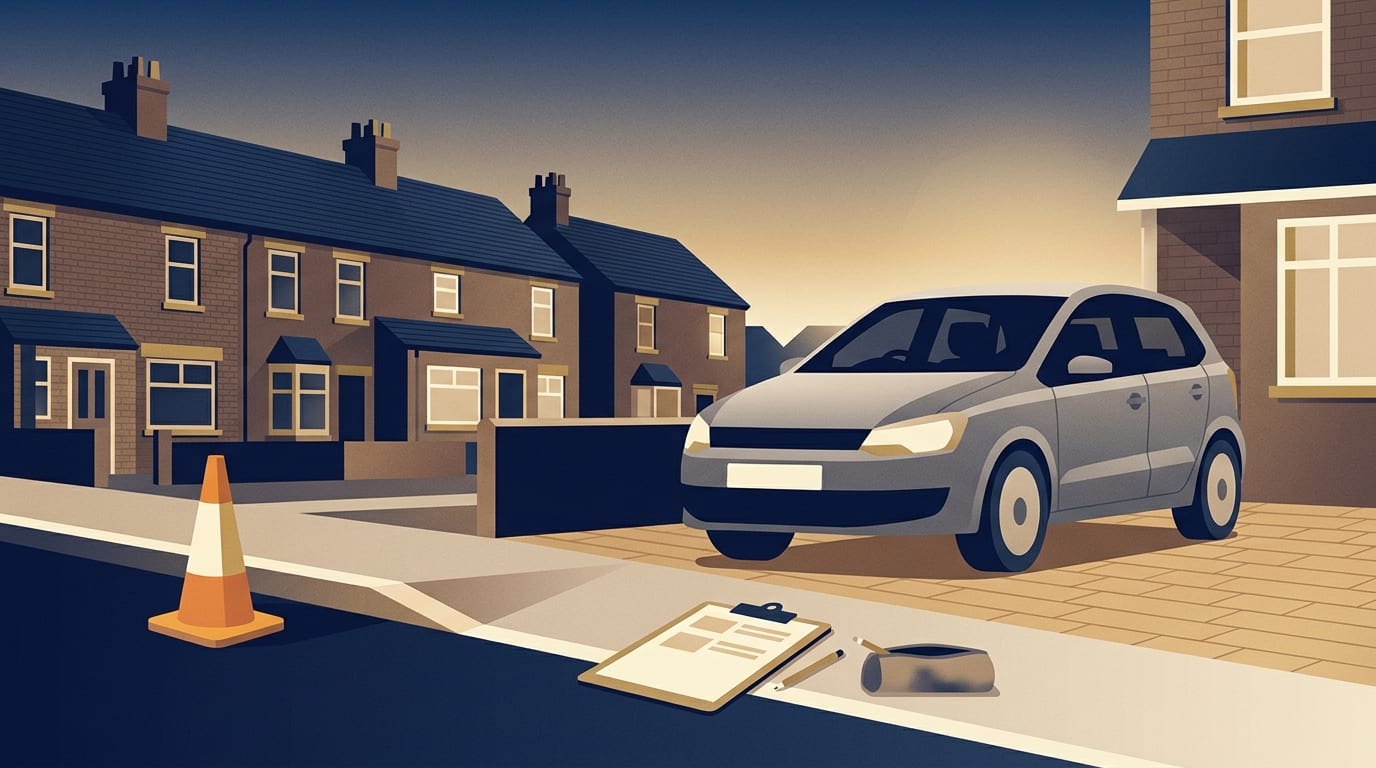
A dropped kerb is a lowered, sloping access point in the pavement that lets you drive a vehicle safely off the road and onto your property. Driving over a pavement onto your property without one is illegal. If you want to create new off-road parking, you must apply to your local authority to drop a kerb. The application process and the fees are set by each individual council, which means there is no single national price. You will need to deal with the council directly, understand their specific rules and pay their non-refundable application fee before any construction begins.
What a dropped kerb is and why you need one
Building a new driveway involves major changes to your outdoor space. A garden designer produces the plan, a landscaper or landscape contractor builds it, and a gardener maintains it. The driveway itself is hard landscaping, which is the built part of a garden. This includes patios, paths, walls, steps, fencing, drainage and decking. For decking, this refers to softwood, hardwood or composite boards and the frame beneath them. Soft landscaping is the living part, including soil, turf, planting and trees.
When you plan a parking area, the boundary between your property and the public road is controlled by the local council. A dropped kerb changes this boundary. The official definition from the Planning Portal is that a dropped kerb is a lowered sloping access point in the pavement. It is required if you wish to drive over a pavement onto your property.
Without this sloping access point, the kerb remains at its full height. Driving a car over a standard raised kerb and across a public pavement is illegal. You cannot simply build a driveway inside your garden and start driving across the pavement to reach it. You must apply to your local authority to drop a kerb first.
Because a dropped kerb sits in the public pavement, the council controls the work. A landscaper may be able to advise you on the driveway layout or manage the job, but the council controls the kerb and decides who may build the crossing.
How the council application works
Because there is no single national system, you must apply to your local authority to drop a kerb. Every council has its own application process, meaning the steps you take will depend on where you live.
Merton Council's steps are one example of how a council can set out the process. They are:
- Read the information pack provided by the council.
- Apply online for the dropped kerb.
- Receive a construction estimate if your application is approved.
- Check whether planning permission is needed for the driveway itself.
- Decide whether to proceed with the work based on the costs and rules.
Merton says it will send a final estimate within six weeks of the application, though other councils differ in their timing.
Surrey County Council breaks its process down into stages. Their Stage 1 application covers the initial assessment, a site visit, marking out the kerb and the administration of the licence. Surrey says its licence is valid for six months, so check how long your own council's licence lasts.
Each council applies its own criteria, so check them before you apply. For a single car, Norfolk County Council states that the upper width of the crossing is normally 2.75 metres, or three edging blocks.
If your application is refused, you will not get your application fee back. Surrey and Norfolk both say so.
Application fees differ by council
When you budget for a dropped kerb, there are two separate costs to consider. The first is the council's application fee, and the second is the construction cost.
The application fee covers the council's time to process your paperwork, assess your property and visit the site. This fee is non-refundable. If your application is refused, or if you decide not to go ahead with the driveway, the council keeps this money.
Application fees differ widely across the country, so you must check your own council's website for the exact figure. The table below shows the fee each of four councils quotes, to illustrate how these upfront charges vary.
|
Council |
Application fee |
What the council says |
|---|---|---|
|
Merton Council |
£235.80 |
Non-refundable fee from 1 April 2026. |
|
Surrey County Council |
£383.00 |
Stage 1 fee, non-refundable even if unsuccessful. |
|
Croydon Council |
£163.60 |
Non-refundable, covers processing and site inspection only. |
|
Norfolk County Council |
£193.92 |
Non-refundable fee from 1 April 2026, not refunded if refused. |
Each figure belongs to the council named beside it. Surrey's is the Stage 1 fee only, and Croydon's does not cover building the crossing. Check your own council's current figure.
What the building work costs
The second cost is the physical construction of the vehicle crossover. This involves lowering the kerb and forming the crossing over the pavement. A sub-base is compacted crushed stone, often called MOT Type 1, used under paving and artificial grass.
Just like the application fee, the construction cost varies depending on your location, the size of the crossing and the specific rules of your council. As a general rule across all trades, work in London and the South East costs more. Norfolk County Council provides a rough guide, stating that a simple residential crossing typically averages about £3,050 at 2026 prices. This is that council's average guide figure, not a national price. The cost of each crossing depends on individual circumstances, such as the required width and any traffic restrictions needed during construction.
When a private contractor does the work, the pricing structure changes. In Surrey, the Stage 2 cost is the quoted amount from your chosen contractor. This money is paid up front and held by the council until the works are complete.
A quote is a fixed price, while an estimate is a rough guess. When you receive a quote for the construction work, it should clearly state the following details:
- The exact excavation depth for the new crossing.
- The depth of the sub-base beneath the surface.
- The named materials to be used for the kerb and paving.
- The drainage plan to handle rainwater.
- The removal of waste from your property.
Any trader who carries waste away from your property must be a registered waste carrier, and this register is public.
Under the Consumer Rights Act 2015, all work must be done with reasonable care and skill. If it is not, the customer can ask for it to be put right or seek a partial or full refund. Citizens Advice suggests getting three written quotes, having a written contract, paying deposits of no more than 25 per cent and paying by card. They also note you might be able to cancel within 14 days of agreeing a contract. If you end up in a dispute over the construction work, you should contact Citizens Advice.
Who is allowed to build a dropped kerb
The council controls the kerb, so you should not arrange the work yourself. Councils take two different approaches to who builds the crossing, and you must check which one your council uses.
Some councils do all the construction work themselves. Merton Council states that only the council can build dropped kerbs, doing so at the request of residents or businesses if criteria are met.
Other councils work differently. Surrey County Council provides a licence pack that includes a list of approved contractors, and the council advises getting at least three quotes.
Because landscaping is not a licensed trade, vetted membership of a trade body and evidence of past work matter when you choose a contractor. The British Association of Landscape Industries (BALI) says its Accredited members are vetted on workmanship, skill and health and safety. The Association of Professional Landscapers (APL) says its members are assessed, regularly inspected and TrustMark accredited. TrustMark is the government-endorsed quality scheme. Membership is a good sign, but it is not a guarantee.
You must remain alert to doorstep callers offering cheap paving or leftover materials. Croydon Council specifically warns residents about rogue traders posing as official council contractors. Always verify a contractor's status directly with the council before handing over any money.
Do you also need planning permission
A dropped kerb application is separate from planning permission. You may need planning permission in addition to your dropped kerb licence.
The rules often depend on the classification of the road you live on. Surrey County Council states that if you live on an A, B or C road you will need planning permission. If you live on a D road, you may need it. In Surrey, you must contact your district or borough council first and provide written proof of whether permission is required before the dropped kerb process can move forward. Processing times for this planning evidence may differ between councils.
If planning permission is needed, it involves a separate application and a separate fee. Croydon Council states that their separate planning application costs £206.
You must also consider the planning rules for the driveway itself. In England, paving more than 5 square metres of a front garden with an impermeable surface that does not drain to a permeable area needs planning permission. Permeable surfacing does not. Permeable surfaces allow water to soak through, while impermeable surfaces block water, requiring a slight slope known as a fall to shed water safely. These permitted development rights apply to houses, not flats or maisonettes, and listed buildings need consent for significant work.
For more details on the rules for the driveway surface, read our guide on driveway planning permission. That guide covers the rules for the driveway surface. You can also read our guide to block paving driveway costs if you are comparing different surface materials.
Why you should not drive over the pavement without one
The Planning Portal states clearly that it is illegal to drive over a pavement onto your property without a lowered sloping access point.
Public pavements are designed for pedestrians rather than vehicles, which is why councils want a properly built crossing. Building a new driveway first and applying afterwards puts you at risk of having a driveway you cannot legally use.
The application fee is non-refundable in every council named above, so read your own council's criteria and information before you apply. Do not pay for driveway materials until you know what the council has decided, because approval is not guaranteed.
Common questions
How much does a dropped kerb cost?
There is no single national price because every council sets its own fees and rules. You will pay a non-refundable application fee, which among the four councils named here runs from £163.60 in Croydon to £383.00 for Surrey's Stage 1, followed by the construction cost. Norfolk County Council cites an average of £3,050 at 2026 prices for a simple residential crossing, but your local quotes will differ.
How do you make a dropped kerb application?
You must apply to your local council. Merton takes applications online and other councils have their own process, so start on your own council's website. The application fee is non-refundable.
How to get a dropped kerb approved?
Each council sets its own criteria and approval is not guaranteed. Read the criteria before you apply and do not pay for driveway materials until you have a decision.
Who provides the dropped kerb contractors?
This depends entirely on your council. Some councils insist their own teams do the building work. Others, such as Surrey, issue a licence pack with a list of approved contractors and advise getting at least three quotes.
Next steps before you book a driveway
Before you hire a landscaper to build a new driveway, you must secure your legal access. Follow these steps to get your project started in the right order:
- Measure your front garden to ensure a car will fit without overhanging the public pavement.
- Check your local council's website for their specific dropped kerb criteria and application fees.
- Find out if you live on a classified road that requires a separate planning permission application.
- Submit your dropped kerb application and pay the non-refundable fee.
- Wait for the council's site assessment and official approval before you pay any deposits for driveway materials.
- Check whether your council will build the crossing or if you need to ask their approved contractors for three written quotes.
When your legal access is approved and you are ready to plan the driveway surface, you can find a landscaper near you to design and build the parking area on your property.
Find a top rated landscaper near you
4,373 landscapers across the UK, each ranked on their Google rating and the number of reviews behind it. Start with your county: