Running bamboo spreads by underground stems called rhizomes that sit in the top 30cm of soil, and any piece left behind with a node can regrow. Complete bamboo removal means digging out the whole plant and tracing every rhizome, which could cost from hundreds of pounds to £2,000+ depending on the spread, access and method. The Royal Horticultural Society says removing mature clumps can be difficult and suggests hiring a specialist company for large stands.
Why bamboo is so hard to get rid of
When you plan soft landscaping, which is the living part of your garden including soil, turf, planting and trees, bamboo often seems like a fast way to create privacy. Most bamboos are either clumping or running types. Running types are the ones most likely to become problematic in gardens.
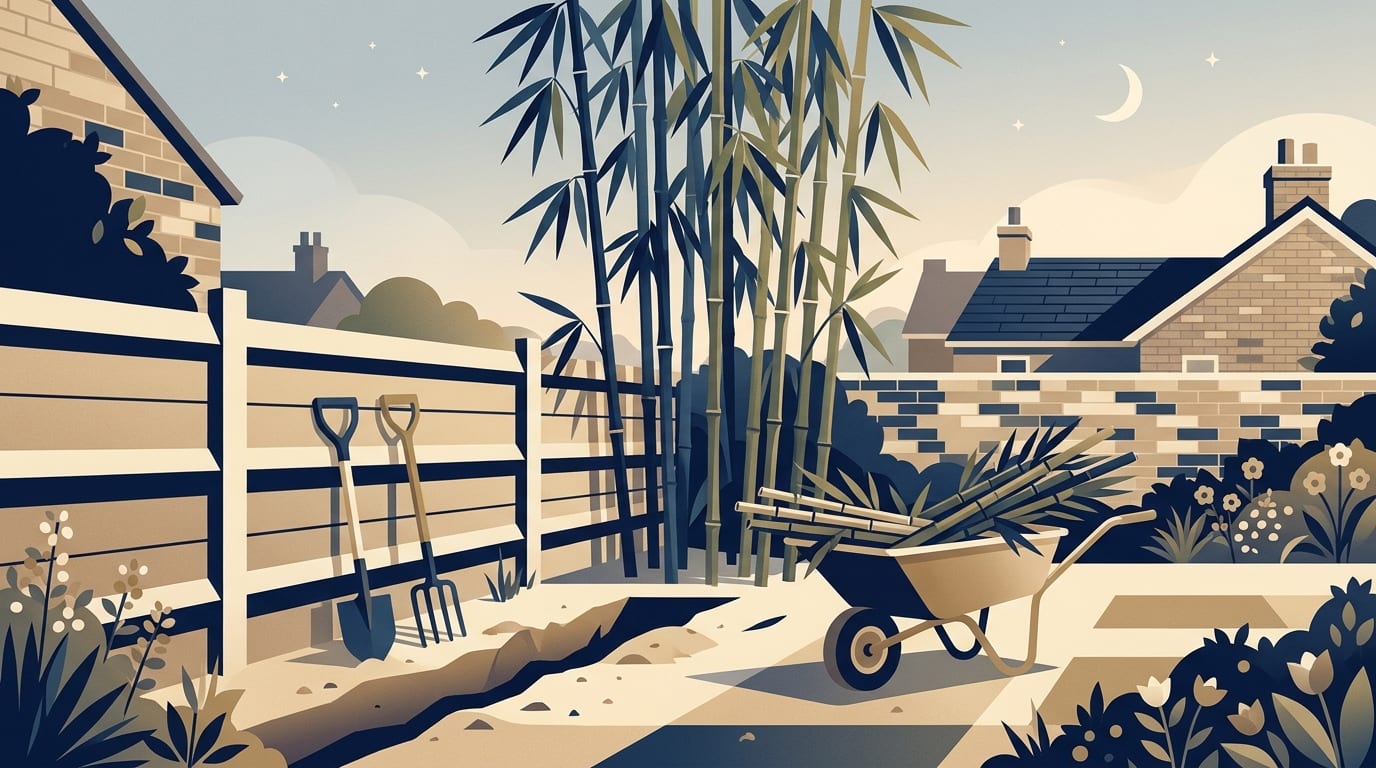
Running bamboos spread by sending out underground stems called rhizomes. These rhizomes can travel a considerable distance from the parent plant, so they can reach well beyond the original planting. They generally grow quite close to the surface, mostly sitting within the top 30cm of the soil.
The main problem with digging running bamboo out is that the rhizomes can regrow from any section that contains a node. A node is a small bump or joint along the stem. If you chop the underground stems with a spade while digging, you can easily spread the plant further around your garden. Every single piece of the rhizome network needs to be traced and removed to stop the plant coming back.
Signs that running bamboo is spreading out of control include:
- New shoots appearing in the middle of your lawn.
- Paving slabs lifting or cracking under the pressure.
- Shoots emerging on the other side of a boundary fence.
- Rhizomes turning up beyond the edge of the original clump.
How professional bamboo removal works
For established plants, the Royal Horticultural Society advises severing any rhizomes you find and removing sections that extend beyond a circular trench. Complete removal means digging out the entire plant and its root system. This is heavy physical work, and the RHS notes that it can be a difficult task on mature, established clumps.
If the plant is old, large, or has spread widely, the RHS suggests you hire in a reputable company that specialises in bamboo removal. While a gardener maintains a garden, a landscaper or landscape contractor is the person who builds it and does the heavy groundwork. They will excavate the main root ball and then carefully trace the rhizomes through the surrounding soil. If you need a completely new layout afterwards, a garden designer produces the plan, and the Society of Garden and Landscape Designers (SGLD) is the professional body for designers.
If the bamboo has spread under your hard landscaping, which is the built part of a garden such as patios, paths, walls, steps, decking and fencing, the job becomes much more complex. The contractor may need to lift paving or dismantle structures to reach the roots underneath. Once the main plant is gone, you will still need to monitor the area for regrowth. Any small shoots that appear over the next few seasons must be dug out immediately before they can establish a new root system.
Root barriers to stop bamboo spreading
When a landscaper removes part of a bamboo stand, or tries to contain one that is spreading from a neighbouring garden, they should specify a root barrier. Root barriers restrict vigorous weeds and invasive plants by confining their roots to a specific area. This is work to specify in the quote rather than a casual DIY task.
The RHS advises digging a trench at least 60cm deep around the plant to install the barrier. Specialist root barrier fabrics are the easiest to install for this purpose. The edges of the fabric must overlap securely, and the joints must be sealed with an appropriate mastic to stop the sharp rhizomes pushing through the gaps.
The barrier must extend above the soil level by at least 7.5cm. This crucial step stops the rhizomes simply growing up and over the top of the barrier to reach the rest of the garden. Once the barrier is installed, the trench should be checked once a year so you can sever any rhizomes attempting to escape.
Materials that can be used to form a straight barrier include:
- Specialist root barrier fabrics with overlapping edges sealed with mastic.
- Paving slabs set vertically in the trench, still rising at least 7.5cm above soil level.
- Corrugated iron sheets set in the trench, also rising at least 7.5cm above soil level.
Why weedkillers are rarely the answer
Many homeowners try to kill running bamboo with chemical weedkillers before they resort to paying for excavation. The RHS does not support the use of weedkillers and recommends that alternative non-chemical control methods are used instead. Check the product label carefully before using any chemical weedkiller.
The RHS adds that it can take several years to kill a bamboo with systemic weedkillers. That is a long time to wait, which is one reason a contractor who digs out the plant and fits a root barrier is the route the RHS points towards for large or mature stands.
What bamboo removal costs and how it is priced
Landscapers price per project after a site visit. There is no standard per-metre price for bamboo removal because the rhizome spread cannot be seen above ground. A contractor cannot price the job accurately without seeing the site and working out how far the rhizomes have spread.
The main cost drivers for any landscaping project are the area, the groundwork required, the soil levels, access, waste removal, drainage and materials. Access is a major factor for terraced houses, as everything carried through the house costs more in time and labour.
The table below shows the typical cost range and the main factors that push the final bill up or down.
|
Removal factor |
How it affects the final quote |
|---|---|
|
Guide cost range |
Hundreds of pounds to £2,000+ |
|
Spread of rhizomes |
Wider spread requires more digging and soil movement |
|
Access to the roots |
Spread under patios or structures may need excavation |
|
Neighbouring land |
Spread across boundaries is more complex to resolve |
|
Treatment method |
Costs vary between full digging and barrier installation |
This range is a guide figure only, not a per-job price, and bamboo removal is not priced per metre. Local quotes will differ based on your specific garden. London and the South East cost more. When you receive a quote, you should always check whether VAT is included in the final figure. Larger jobs are usually paid in stages as the work progresses.
Is bamboo illegal like Japanese knotweed?
When an invasive plant takes over a garden, it is common to assume it must be against the law to grow it. Bamboo is not listed under the Wildlife and Countryside Act 1981, so it is not regulated in the same way as Japanese knotweed or giant hogweed, which are listed on Schedule 9 of the Wildlife and Countryside Act 1981.
Homeowner advice describes bamboo as not legally classified as an invasive plant in the UK, but that does not mean it cannot cause problems. If you suspect you have Japanese knotweed in your garden, the rules and the removal methods are entirely different.
However, you are still responsible for what grows on your property. If your running bamboo spreads onto a neighbour's land or causes damage to a boundary wall or patio, it can still lead to a civil dispute between neighbours. Check with your local council if you have concerns about plants crossing boundaries.
What goes wrong with cheap removal jobs
The groundwork nobody sees is where corners get cut in landscaping. If you accept a cash deal with no written specification, you have no proof of what the contractor agreed to do. Doorstep callers often offer cheap garden clearance or leftover materials, but they may not trace every bamboo rhizome.
If bamboo has ruined a patio and you hire a cheap contractor to replace it, they might leave the roots in the ground. A good patio requires a proper sub-base, which is compacted crushed stone, often called MOT Type 1, laid under the paving. Bad contractors might use a thin or missing sub-base, or lay the slabs on dabs of mortar instead of a full bed. If the bamboo regrows under this weak structure, it can lift the new slabs.
Similarly, a bad operator might lay artificial grass straight onto the soil over the old bamboo roots. Rhizomes left in the ground can push up through the new surface. Good landscaping requires all the living roots to be removed or contained before any new surfaces are laid. If a patio is being rebuilt after bamboo removal, it also needs the correct falls, which is the slight slope that sheds water, so that water does not pool or run towards the house.
Waste disposal and your legal duty
Digging out a mature bamboo stand generates a large amount of heavy green waste, roots and soil. Under the government duty of care code, householders must take reasonable measures to ensure they only transfer waste to an authorised person. You cannot simply hand it to a doorstep caller who offers to take it away for a cheap cash price.
You must check that the business taking your waste is an authorised carrier with up to date and valid upper tier registration. In England, you can search the Environment Agency online public register by registration number, business name or postcode, or you can call them on 03708 506 506. The register is public and easy to use.
When you compare quotes, ask the contractor exactly how the rhizomes will be disposed of. The quote should clearly state that waste removal is included in the price. Understanding your garden clearance cost and waste responsibilities is the best way to ensure your old bamboo does not end up fly-tipped.
Common questions
Do I need planning permission to repair a fence damaged by bamboo?
In England, fences and walls can be up to 1 metre high next to a road or its footpath and 2 metres elsewhere under permitted development, per the Planning Portal. Check with your local council if you are unsure whether a replacement fence fits those rules. These permitted development rights apply to houses, not flats or maisonettes, and listed buildings will need consent for significant work.
Can bamboo damage protected trees in my garden?
If you need to dig near a protected tree to remove bamboo, speak to your council first. A Tree Preservation Order makes it an offence to cut down, lop, uproot or damage a protected tree without the council's consent. Work on trees in a conservation area normally needs six weeks' notice to the council.
Will running bamboo grow through my garden decking?
Spread under patios or structures such as decking is more complex to deal with and may need excavation. A deck consists of the surface boards, which can be softwood, hardwood or composite boards, and the frame beneath them. In England, decking is permitted development if it is no more than 30cm above the ground and, with extensions and outbuildings, covers no more than 50 per cent of the garden.
What rights do I have if the landscaper does a bad job?
Under the Consumer Rights Act 2015, any landscaping work must be done with reasonable care and skill. If the contractor fails to do this, you can ask for the work to be put right or seek a partial or full refund. Citizens Advice is the best place to go for help with disputes, and they suggest paying by card.
How do I know if a landscaper is qualified?
Landscaping is not a licensed trade, so vetted membership and evidence of past work matter much more than certificates. The British Association of Landscape Industries (BALI) says its Accredited members are vetted on workmanship, skill and health and safety. The Association of Professional Landscapers (APL) says members are assessed, regularly inspected and TrustMark accredited. TrustMark is the government-endorsed quality scheme. Membership is a good sign, though not a guarantee.
Next steps before you hire someone
Before you agree to any work, you need a firm written quote rather than an estimate. An estimate is a rough guess, whereas a quote is a fixed price for the job. Citizens Advice suggests getting three written quotes, getting a written contract, paying deposits of no more than 25 per cent, and checking if you might be able to cancel within 14 days of agreeing a contract.
A good written specification from a landscaper should state:
- The exact depth of excavation required to remove the root ball.
- Confirmation that rhizomes will be traced beyond the main clump.
- Whether a root barrier is being fitted and exactly what materials will be used.
- Details of the waste removal and the contractor's upper tier registration.
- A plan for monitoring the area for regrowth in the seasons following the removal.
Taking the time to check these details ensures you are comparing your quotes fairly. A proper specification proves that the contractor understands the scale of the job and is not planning to cut corners on the groundwork. Once you know exactly what needs to be done and how the waste will be handled, you can find a landscaper near you to clear your garden for good.
Find a top rated landscaper near you
4,373 landscapers across the UK, each ranked on their Google rating and the number of reviews behind it. Start with your county: