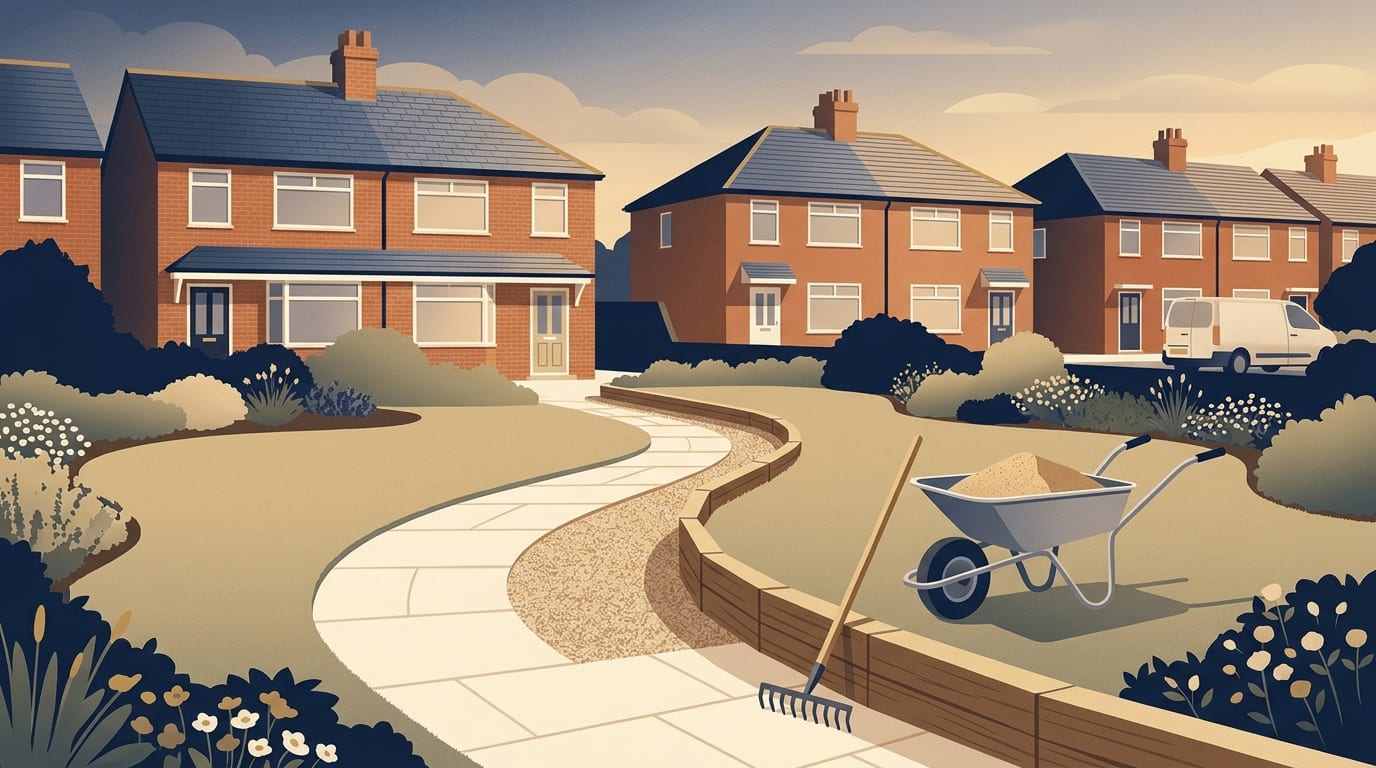
The cost of a new garden path depends mostly on the material you choose, the width of the walkway and the condition of the ground underneath. Landscapers price path projects based on the total area to be covered rather than just the length. A simple gravel or bark path sits at the cheaper end, while natural stone or porcelain sits at the top of the range.
The table below shows a comparison of typical supply-and-lay prices per square metre for the most common path materials. These are typical 2026 prices, and local quotes will differ based on the specifics of your garden.
|
Path material |
Typical supply-and-lay cost per square metre |
|---|---|
|
Loose gravel or shingle |
£40 to £70 |
|
Poured concrete |
£60 to £90 |
|
Block paving |
£80 to £140 |
|
Resin-bound |
£90 to £150 |
|
Natural stone or sandstone flags |
£120 to £200 |
|
Porcelain paving |
£130 to £200 |
These figures are typical 2026 prices. Always ask your landscaper to confirm whether the quote includes VAT.
Price by material
The surface you choose is the most visible part of your budget. Hard landscaping refers to the built part of a garden, which includes paths, patios, walls, steps, decking, fencing and drainage. Soft landscaping is the living part, such as soil, turf, planting and trees. Most path installations fall entirely under hard landscaping, and the chosen material dictates how long the job will take.
Natural stone and porcelain paving sit at the higher end of the price scale. These materials need a solid foundation and careful levelling. Poured concrete, block paving and resin-bound surfaces sit in the middle of the price range. This is similar to pricing a larger seating area, where you can read about how much a new patio costs to understand the heavy groundwork involved.
Gravel is one of the cheaper path materials. Other 2026 figures put a gravel path or border at £8 to £30 per square metre installed, and £8 to £20 per square metre for supply only. The two sets of figures define gravel work differently, so they do not match and should not be combined. Check exactly what a quote covers. A detailed quote should state whether excavation, sub-base preparation, edging and waste removal are included in the final price.
While paths are often paved or covered in stone, you might also want a boardwalk style path. If you are considering this route, you must distinguish between softwood, hardwood and composite boards, as well as the timber frame beneath them. Each type of board carries a different price point and maintenance requirement.
Price per metre and why width matters
Most domestic paths are 0.6 metres to 1.2 metres wide. While landscapers calculate their costs by the square metre, it is often easier for a homeowner to picture the price per linear metre. The table below shows the typical cost per linear metre for a path that is 0.9 metres wide.
|
Path material |
Typical cost per linear metre (0.9m wide) |
|---|---|
|
Loose gravel |
£36 to £63 |
|
Poured concrete |
£54 to £81 |
|
Block paving |
£72 to £126 |
|
Resin-bound |
£81 to £135 |
|
Sandstone or porcelain |
£108 to £180 |
These figures are typical 2026 prices based on a 0.9-metre width, and local quotes will differ. The width of your path changes the cost in ways that are not always obvious. A 0.6-metre path can cost 15 to 20 per cent more per square metre than the exact same material laid at a 1.2-metre width.
A likely reason is that fixed costs such as setup, machinery hire and delivery are spread over less area. You pay for the true area of the path, which is the length multiplied by the width, rather than the length alone.
Edging restraints and their costs
A path needs a solid boundary to keep the surface material in place. Without a proper restraint, gravel will spill into your flowerbeds and paving slabs will gradually shift outwards under the weight of foot traffic. You should budget 12 to 30 pounds per linear metre of edge, and you must allow for two edges when calculating the total length needed for your path.
There are several edging options, including a haunched kerb, timber, a brick soldier course and steel. A brick soldier course is a line of bricks standing upright on their ends. Ask each landscaper which edging they have priced, because the budget figure above applies to all of these options.
Sub-base and groundwork preparation
The groundwork nobody sees is where corners get cut by bad tradespeople. A path is only as strong as the ground beneath it. The foundation layer is called the sub-base, which is made of compacted crushed stone, often referred to as MOT Type 1. This stone locks together when compressed by a heavy plate compactor, creating a solid, load-bearing platform.
The depth of this sub-base dictates how much weight the path can handle. A sub-base of 75 to 100 millimetres of MOT Type 1 is the depth given for foot traffic. If you plan to move wheelbarrows, mowers or vehicles over the path, the figure given is 100 to 150 millimetres.
Sloping, soft or root-filled ground makes groundwork much more complicated. These conditions add cut-and-fill work to the job, which means the landscaper must dig out soil from high spots and move it to low spots to create a level surface. This extra digging creates additional spoil that must be removed from your garden, pushing the price up further.
Drainage and managing slopes
Water management is a major factor in landscaping costs. A well-built path incorporates falls, which is the slight slope built into the surface that sheds water away naturally. If a path is built completely flat with no fall, water will pool on the surface or run directly towards your house, causing damp problems.
Paths are either permeable or impermeable. Permeable surfaces, like loose gravel, allow rainwater to drain naturally through the path and into the ground below. Impermeable surfaces, such as concrete or fully pointed porcelain paving, block water from soaking away. Impermeable surfaces may need a soakaway or a channel drain installed to manage the runoff, which will add 150 to 500 pounds to the project.
Building a path on a slope also increases the cost. Curves and steps waste material because paving slabs must be cut to unusual shapes, and this slow cutting work extends the time the landscaper spends on site. If your garden features significant level changes, you can read about how much it costs to build garden steps to handle the height difference properly.
Access and waste removal
The route between the road and your garden has a massive impact on the final quote. If your landscaper can drive a mini excavator and a tracked barrow straight down the side of your house, the groundwork will be finished quickly. If you live in a terraced house with no side alley, access becomes a problem.
Everything carried through the house costs more. Moving tonnes of crushed stone, paving slabs and wet concrete through a residential hallway by hand is slow and exhausting work. Barrowing materials through the house can double the groundwork labour costs for a path project.
Getting rid of the old soil and rubble adds to the cost. A skip alone is £200 to £350, and a long path can generate a lot of soil. A trader who carries waste away from your property must be a registered waste carrier, and this register is public so you can check their credentials before they start work.
Gravel paths and their trade-offs
Gravel is a highly popular choice for garden paths because it is fast to lay and easy on the budget. A standard gravel path takes half a day to one day to install completely. It is significantly cheaper than paving or decking, making it an excellent option for long paths that wind down to a garden shed or a rear gate.
There are trade-offs to choosing a loose surface. Gravel spreads onto lawns and patios over time, which means you will occasionally need to sweep stones back into place or top up the surface with fresh material. If you want to use this stone extensively, you can read more about whether gravel is a good choice for your outdoor space.
Gravel is also less durable than paving in high-traffic areas. A paved path using concrete slabs or natural stone costs more upfront than gravel, but it offers far greater durability for busy walkways.
How to get a like-for-like quote
Landscapers price per project after a site visit. You cannot get an accurate price over the phone because the contractor needs to measure the area, test the ground and assess the access routes. London and the South East cost more for both labour and materials than the rest of the UK.
You must understand the difference between a quote and an estimate. A quote is a fixed price for the exact work agreed. An estimate is a rough guess that can easily increase once the digging starts. Citizens Advice suggests getting three written quotes, signing a written contract, paying deposits of no more than 25 per cent and paying by card.
A good written specification should state exactly what you are paying for so you can compare contractors fairly. Your written quotes should include these details:
- The exact excavation depth in millimetres
- The depth of the sub-base and the type of stone used
- The named materials for the surface and the edging
- How drainage and falls will be managed
- Whether waste removal and skip hire are included in the final price
Landscaping is not a licensed trade, which means anyone can buy a van and offer paving services. Vetted membership and evidence of past work matter greatly. The British Association of Landscape Industries (BALI) says its Accredited members are vetted on workmanship, skill and health and safety. The Association of Professional Landscapers (APL) says members are assessed, regularly inspected and TrustMark accredited. TrustMark is the government-endorsed quality scheme. Membership of these bodies is a good sign of a serious business, though it is not a guarantee of a perfect job.
What goes wrong with path installations
Bad landscaping usually starts with a deal that looks too good to be true. Doorstep callers offering cheap paving or leftover materials from a job down the road are a common problem. These traders often demand cash deals with no written specification, leaving you with no paperwork to rely on when things fail.
A thin or missing sub-base is a common failure. Without enough compacted stone underneath, the path can sink unevenly. Another frequent shortcut is slabs laid on dabs of mortar instead of a full bed. This leaves hollow voids under the paving, which causes the slabs to rock, crack and trap freezing water in the winter.
You should also avoid contractors who lay artificial grass straight onto soil, or who build paved paths with no fall so that water pools on the surface. Under the Consumer Rights Act 2015, work must be done with reasonable care and skill. If it is not, the customer can ask for it to be put right or seek a partial or full refund. You might also be able to cancel within 14 days of agreeing a contract. For any disputes, you should point your questions to Citizens Advice.
Common questions
Do I need planning permission for a garden path?
Planning rules in England, per the Planning Portal, state that paving more than 5 square metres of a front garden with an impermeable surface that does not drain to a permeable area needs planning permission. Permeable surfacing does not need permission. These permitted development rights apply to houses, not flats or maisonettes. Listed buildings need consent for significant work. If you live outside England or are unsure, you should check with your local council.
Should I hire a garden designer, a landscaper or a gardener?
A garden designer produces the plan for the space. A landscaper or landscape contractor builds the heavy, structural elements like the path and the sub-base. A gardener maintains the plants and the lawn once the build is finished. The Society of Garden and Landscape Designers (SGLD) is the professional body for designers. Design fees are usually separate from the landscaping build cost.
What happens if my path runs near a protected tree?
A Tree Preservation Order makes it an offence to cut down, lop, uproot or damage a protected tree without the council's consent. Digging for a path near a protected tree could damage its roots, so check with the council before any work starts. Work on trees in a conservation area normally needs six weeks' notice to the council.
Why do quotes for the exact same path vary so much?
Quotes differ mostly because contractors plan different levels of groundwork. One landscaper might quote for digging out 150 millimetres of soil, laying a proper MOT Type 1 sub-base and hiring a skip for the waste. Another might plan to scrape away just the top layer of grass and lay the path on soft soil, leaving the waste in your garden. Always check the written specification.
Next steps for your garden path project
Before you contact local tradespeople to price your new path, you need to decide exactly what you want the space to do. Having a clear plan stops the budget running away and ensures all your quotes cover the exact same work. Follow these steps to get your project moving:
- Decide whether you want a cheap, permeable gravel path or a highly durable paved surface
- Measure the required width, remembering that narrow paths cost more per square metre
- Look at how materials will be carried from the road to the garden
- Ask three different contractors for a written quote after a site visit
- Check that each quote lists the excavation depth, sub-base depth and waste removal costs
- Look for evidence of previous work and check for vetted memberships like BALI or APL
Taking the time to understand the groundwork will protect you from cowboy pavers and sinking slabs. Once you know what materials you want and what the sub-base should look like, you can find a landscaper near you to inspect the ground and provide a firm, written quote for the job.
Find a top rated landscaper near you
4,373 landscapers across the UK, each ranked on their Google rating and the number of reviews behind it. Start with your county: