The longest-lasting garden edging options are the heavy ones, such as brick, concrete, stone and good-quality metal, while plastic and softwood timber wear out soonest. The lifespan figures given for different materials come from sellers and are estimates rather than guarantees. Supply-only prices run from £1 to £50 per metre for most lawn and border edging, depending on the material you choose.
When you are planning work on your garden, whether it is a simple border update or a full redesign, picking the right edge matters. Edging keeps the shape of a lawn, makes edge trimming easier and helps keep mulch in place. This guide covers how metal, timber, brick, stone, concrete and plastic edging compare on how long each lasts, what each costs, and whether you can fit it yourself or need to pay a professional landscaper.
What garden edging does
When you plan garden edging ideas, you are working on the line where hard and soft landscaping meet. Hard landscaping is the built part of a garden, which includes patios, paths, walls, steps, decking, fencing and drainage. Soft landscaping is the living part, covering the soil, turf, planting and trees. Edging sits right on the line between the two.
For structures like decking, you must distinguish between softwood, hardwood and composite boards, as well as the timber frame beneath them. However, garden border edging itself is simpler. Installing wood or metal edging helps to retain the shape of a lawn and makes edge trimming easier. A well-defined lawn edge with a decent drop down to the border also helps to keep mulching material in place.
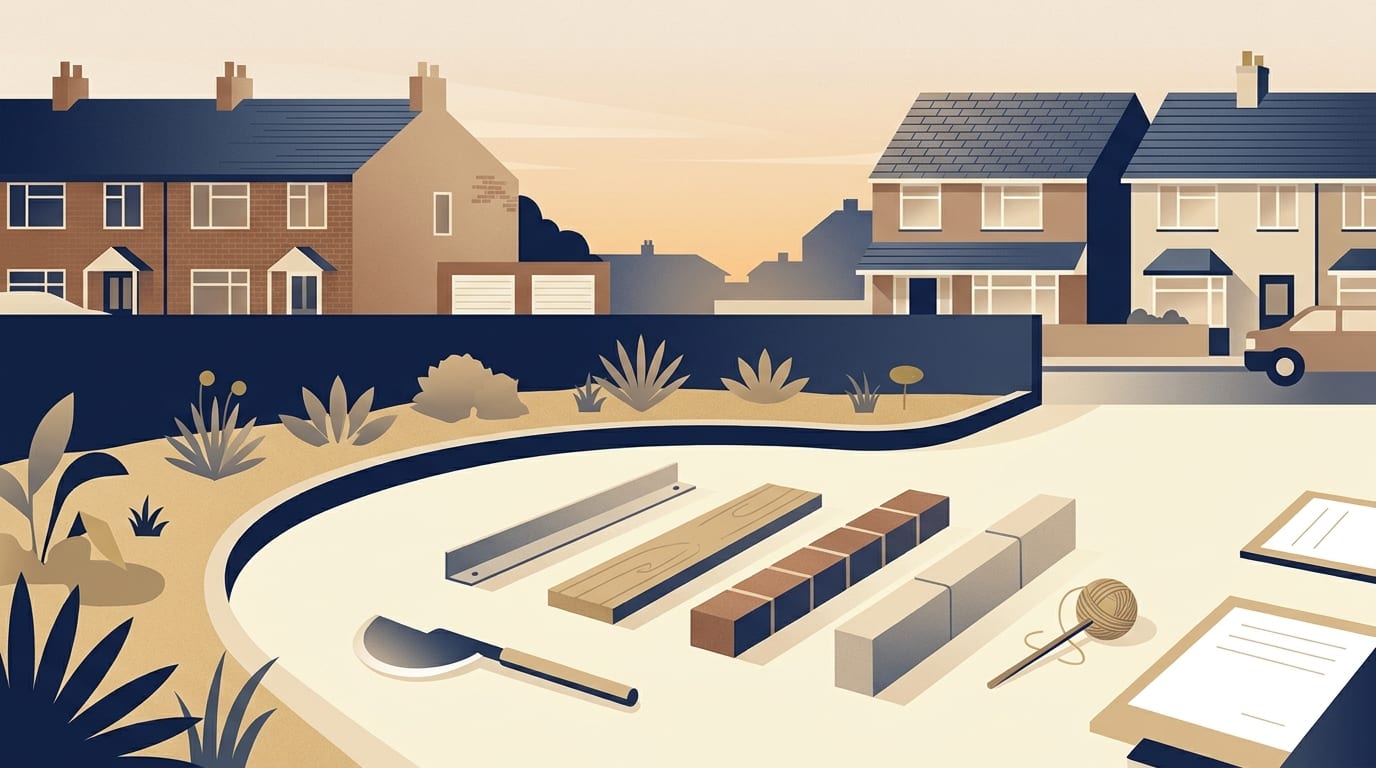
Creating the lawn edge itself without adding a hard material is a simple job you can do with a spade. The RHS says to mark the line of a lawn edge with a string line for straight edges, or a hose, rope or string for curves. You then cut the edge with a half-moon edger or a flat-backed spade marked to a depth of 7.5cm. By overlapping the cuts slightly, you ensure the edge is continuous.
Which type of garden edging lasts longest
The table below shows how long different materials are expected to last before they need replacing.
|
Material |
Lifespan stated |
Main drawback |
|---|---|---|
|
Rolled plastic |
Two to three years |
Needs replacing soonest |
|
Timber edging (seller's estimate) |
Three to seven years |
Ground contact causes rot |
|
Treated timber board (price list estimate) |
Five to twelve years |
Ground contact causes rot |
|
Weathering steel |
Ten years or more on average |
Not a guaranteed minimum |
|
Premium steel |
Decades when correctly specified and installed |
Cheap powder coats can crack or flake |
These lifespans are estimates from sellers and price lists, not guarantees.
Brick, stone and concrete are left out of the table because no lifespan estimate is available for them. Concrete kerbing is highly durable and holds its position well. Brick is extremely durable when well laid, though it is impractical for curves or large areas. Wooden sleepers are long-lasting if properly treated, but they are heavy and can split and decay over time. Pavers can shift in frost-prone or waterlogged ground.
How long timber edging lasts
Estimates for timber vary. Some put the lifespan of timber edging at three to seven years, while others put it at five to twelve years. The main problem with wood is that ground contact causes rot.
Wooden sleepers offer a thicker alternative to timber boards or log rolls. New sleepers are long-lasting if they are properly treated before they go into the ground. However, they are heavy to move into place and can still split and decay as they age.
Is metal garden edging worth the extra cost?
Metal garden edging tends to cost more than timber or plastic and can last longer. Weathering steel, often sold as corten steel, averages ten years or more in the ground. This is an average rather than a guaranteed minimum, but corten steel outlasts soft timber in wet British winters.
Premium steel edging can last for decades when it is correctly specified and installed. You need to choose the right finish, as unprotected mild steel corrodes, and cheap powder coats can crack or flake off. Metal edging comes in standard heights of 75mm, 100mm and 150mm. Edging is set with its top edge flush with, or slightly proud of, the adjacent finish.
For larger structures, a steel edging supplier puts supply-only raised bed edging between 300mm and 600mm high at £70 to £200 per metre. Retaining wall edging between 300mm and 1500mm high costs £95 to £350 or more per metre. This higher price includes the foundation and base preparation needed for structural retention.
Brick, stone and concrete edging compared
Heavy materials create a permanent border but usually need professional help to install. Concrete kerbing is highly durable and holds its position well, but laying it is labour-intensive. It usually needs groundwork and is hard to reposition once it is set. Brick is extremely durable when well laid but expensive. It usually needs professional installation and is impractical for curves or large areas.
Fitting concrete, brick or heavy kerbing is landscaper work. It involves digging a trench and laying a compacted sub-base. A sub-base is a layer of compacted crushed stone, often called MOT Type 1, which sits under paving and heavy edging to provide a stable foundation. Haunching means banking concrete up the hidden sides of an edging stone to hold it in place.
The groundwork nobody sees is where corners get cut. A bad installation might feature a thin or missing sub-base, or slabs laid on dabs of mortar instead of a full bed. Another sign of poor work is having no fall. A fall is the slight slope that sheds water from a surface. Without a fall, water pools or runs towards the house. If you are planning a wider garden update, you might want to look at how much a new garden path costs to see where brick or stone edges fit into the budget.
How much garden edging costs per metre
The table below shows typical supply-only prices per metre for different edging materials. These figures exclude labour, so you will need to add the cost of a landscaper's time if you are not fitting the edge yourself.
|
Material |
Supply-only price per metre |
|---|---|
|
Plastic strip |
£1 to £4 |
|
Treated timber board |
£2 to £6 |
|
Log roll |
£4 to £10 |
|
Galvanised steel strip |
£5 to £14 |
|
Engineering brick course |
£6 to £16 (materials only) |
|
Aluminium strip |
£8 to £20 |
|
New sleepers |
£10 to £30 |
|
Corten steel strip |
£12 to £28 |
|
Natural stone, setts and cobbles |
£14 to £45 |
|
Edging stones |
£20 to £50 |
These are typical prices for 2026, and local quotes will differ. You should also check whether your supplier or landscaper has included VAT in their prices. Standard lawn and flower border steel edging between 50mm and 200mm high sits at £5 to £15 per metre supply-only based on 2025 figures.
Landscapers price per project after a site visit. The main cost drivers for any landscaping job are the area, groundwork, levels, access, waste removal, drainage and materials. Everything carried through the house costs more because of the extra time and care required. London and the South East also cost more than other parts of the UK.
Design fees are usually separate, and larger jobs are paid in stages. If you want a landscaper to supply and fit concrete edging, the costs are higher because of the labour involved. Typical 2026 prices put pre-formed concrete edging at £50 to £130 per linear metre. This breaks down as £20 to £30 for the supply of materials and £30 to £100 for the labour. Flat or bull nose concrete edging also costs £50 to £130 per linear metre.
Poured concrete edging costs £95 to £185 per linear metre, splitting into £50 to £60 for materials and £45 to £125 for labour. A tradesperson will likely charge around £15 to £25 per hour for this work. Pre-formed edging takes an estimated two to four hours to fit, while poured edging takes three to five hours. Ask for a written quote for fitting timber, metal or brick edging, because installed prices depend on the job.
Driveway edging
Firm materials such as concrete or setts suit driveway edges that take wheels. Ask a landscaper for a written quote for driveway edging.
When changing a driveway, you must consider planning rules for paving. In England, paving more than 5 square metres of a front garden with an impermeable surface that does not drain to a permeable area needs planning permission. An impermeable surface is one that water cannot soak through, like standard concrete or tarmac. Permeable surfacing does allow water through and does not need permission.
These rights apply to houses, not flats or maisonettes, and listed buildings need consent for significant work. You can check the Planning Portal in England, or contact your local council if you live elsewhere or are unsure. If you are comparing driveway surfaces, you might also look at how much a gravel driveway costs before you decide on the edge.
Hiring a landscaper and what a quote should include
If you are planning a large project, it helps to understand the different roles. A garden designer produces the plan, a landscaper or landscape contractor builds it, and a gardener maintains it. Installing heavy brick, stone or concrete edging is a job for a landscaper.
Landscaping is not a licensed trade, so vetted membership and evidence of past work matter. The British Association of Landscape Industries (BALI) says its Accredited members are vetted on workmanship, skill and health and safety. The Association of Professional Landscapers (APL) says its members are assessed, regularly inspected and TrustMark accredited. TrustMark is the government-endorsed quality scheme. If you are using a designer, the Society of Garden and Landscape Designers (SGLD) is the professional body for designers. Membership of these bodies is a good sign, not a guarantee.
If your edging work involves trees, be aware of the rules. A Tree Preservation Order makes it an offence to cut down, lop, uproot or damage a protected tree without the council's consent. Work on trees in a conservation area normally needs six weeks' notice to the council. In England, fences and walls can be up to 1 metre high next to a road or its footpath and 2 metres elsewhere without planning permission. In England, decking is permitted development if it is no more than 30cm above the ground and, with extensions and outbuildings, covers no more than 50 per cent of the garden.
A quote is a fixed total price, while an estimate is just a rough guess. Citizens Advice says you should get written quotes from at least three different traders. A quote should be a fixed total price rather than a daily rate, and it should include a breakdown of the work and materials. It should also say how long the price is valid and whether it includes VAT.
For a garden edging project, a good written quote should state:
- The total length of the edging in metres.
- The exact material and its height.
- The depth of the trench or the concrete haunching used to secure the edge.
- The excavation depth and the named materials used for the sub-base.
- How the new edge meets your existing lawn or paving.
- The removal and disposal of all soil and waste from the site.
A trader who carries waste must be a registered waste carrier, and the register is public. Under the Consumer Rights Act 2015, all work must be done with reasonable care and skill. If it is not, the customer can ask for it to be put right or seek a partial or full refund. Citizens Advice suggests paying deposits of no more than 25 per cent and paying by card, and says you might be able to cancel within 14 days of agreeing a contract. Point any disputes to Citizens Advice.
You should also watch out for common signs of bad work when hiring someone. Avoid these red flags:
- Doorstep callers offering cheap paving or leftover materials.
- Cash deals with no written specification.
- A thin or missing sub-base beneath heavy edging.
- Slabs laid on dabs of mortar instead of a full bed.
- No fall on nearby surfaces, so water pools or runs towards the house.
- Artificial grass laid straight onto soil.
Common questions
Which edging is best for curves?
The RHS points out that broad, sweeping curves are easier to maintain than intricate ones. Brick is impractical for curves, and concrete kerbing is hard to reposition once laid. To plan a curve, mark the line with a hose, rope or string first.
Can I edge my lawn in winter?
You can create a new lawn edge at any time of year. The RHS says you just need to avoid working on the grass if the ground is frozen or very wet.
Does plastic garden edging last?
Plastic is the cheapest option but it has the shortest lifespan. A seller's estimate is that most rolled plastic products need replacing within two to three years.
What are the best garden edging ideas for low maintenance?
Heavy materials like brick, concrete or premium metal edging are the longest lasting, so they should need replacing least often. The RHS notes that broad, sweeping curves are easier to maintain than intricate ones. A well-defined edge with a decent drop also helps keep mulching material in place.
How does garden border edging help a lawn?
Installing wood or metal edging helps to retain the shape of a lawn and makes edge trimming easier, according to the RHS.
What to do next
Before you contact a landscaper, make a few basic decisions about your garden so you can ask for an accurate price.
- Decide the exact line of your new edge and measure the length in metres.
- Choose your preferred material based on your budget and how long you want it to last.
- Decide the height of the edging and whether you want it to sit flush with the lawn or stand slightly proud.
- Ask at least three local landscapers for a detailed written quote.
Once you have your measurements and material in mind, you can find a landscaper near you to get a fixed price for the work.
Find a top rated landscaper near you
4,475 landscapers across the UK, each ranked on their Google rating and the number of reviews behind it. Start with your county: