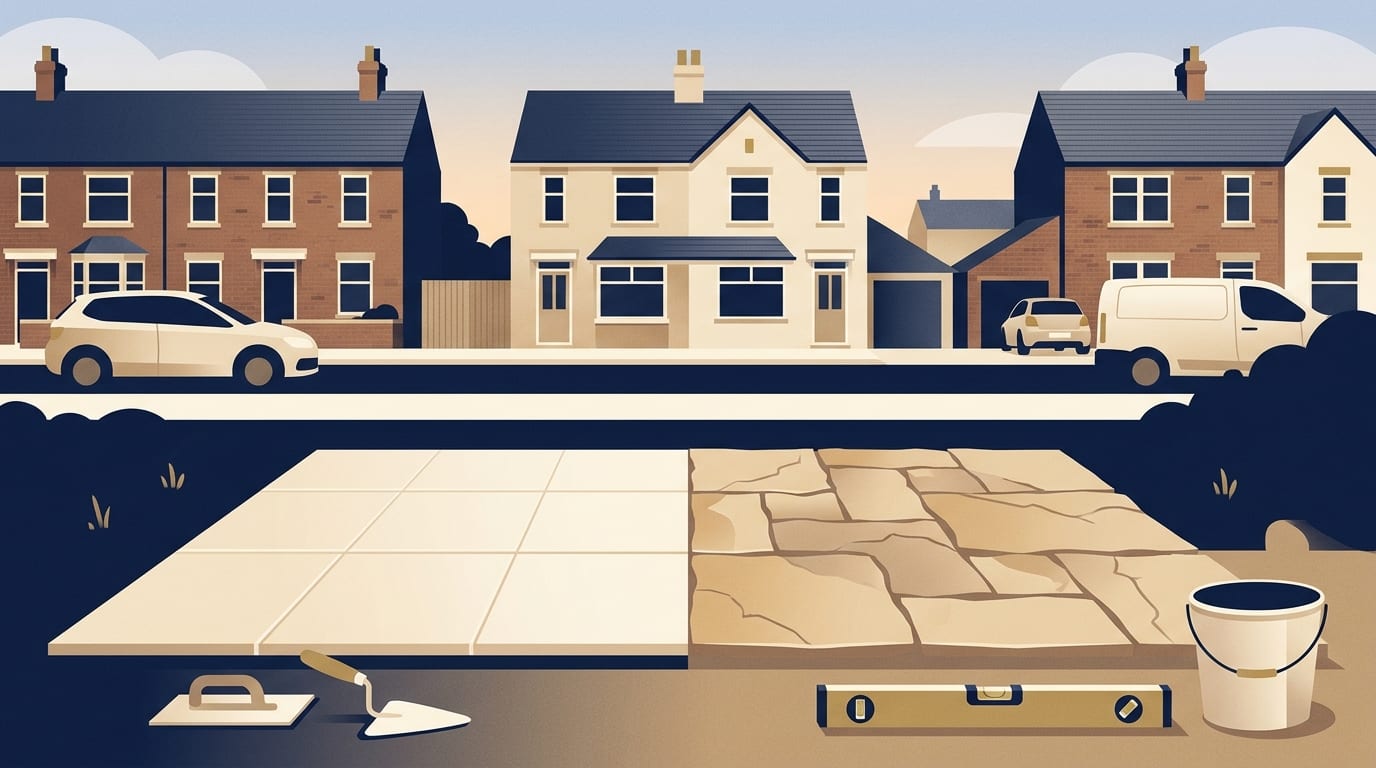
Neither material is better in every garden, but porcelain usually costs more to buy and to fit. This is because porcelain requires a specific bonding method to stick to the base, which adds to the labour time. Natural stone such as Indian sandstone is generally the cheaper natural option for a new patio.
Porcelain paving or natural stone at a glance
Before choosing your patio slabs, it helps to understand how the trade breaks down garden projects. Hard landscaping is the built part of a garden, which includes patios, paths, walls, steps, decking, fencing and drainage. Soft landscaping is the living part, such as soil, turf, planting and trees.
When you plan a new patio or a full garden redesign, a garden designer produces the plan, a landscaper or landscape contractor builds it, and a gardener maintains it. The Society of Garden and Landscape Designers (SGLD, formerly the Society of Garden Designers) is the professional body for designers.
Porcelain is a manufactured slab described as hard-wearing, frost-proof and resistant to stains and fading. Indian sandstone is a natural material and is described as the most affordable natural stone. Both materials are widely used, but they demand different approaches from your landscaper.
Understanding how these materials behave and how a patio should be laid will help you spot a good quote and avoid poor workmanship. Badly laid patios can suffer from water pooling or slabs coming loose.
What each costs in 2026
Landscapers price per project after a site visit. You should never mix supply-only prices with fitted prices, as they measure completely different things. The main cost drivers for any patio are the area, the groundwork, the levels, access, waste removal, drainage and the materials.
Access is a major factor because everything carried through the house costs more in labour. The table below shows supply and labour costs separately.
|
Material or labour |
Typical price per square metre |
|---|---|
|
Indian sandstone supply only |
£40 to £55 |
|
Porcelain supply only |
£50 to £100 |
|
Labour only |
£20 to £40 |
These are typical 2026 guide prices for supply or labour only, and local quotes will differ. Labour is roughly 25 per cent to 35 per cent of the total project cost. For context, gardener day rates are £150 to £200, and with two people on site, labour is about £300 to £400 per day. London and the South East cost more, and you should always check whether VAT is included in your new patio cost.
Tradespeople often give rough fitted estimates based on previous jobs. The next table shows fitted prices and 20 square metre project totals quoted by tradespeople on a question and answer page in August and September 2026.
|
Tradesperson quote |
Sandstone, 20 square metres |
Porcelain, 20 square metres |
|---|---|---|
|
Tradesperson one for 20 square metres |
£2,500 to £3,200 |
£3,500 to £3,800 |
|
Tradesperson two for 20 square metres |
£1,500 to £2,500 |
£2,000 to £3,500 |
|
Tradesperson three for 20 square metres |
Not quoted |
£2,500 to £3,500 |
These figures are rough 2026 estimates from individual tradespeople, not a set price list, and local quotes will differ. Separately, tradespeople gave fitted porcelain prices per square metre of £110 to £200, £120 to £180, about £120 and about £150. One tradesperson noted that Indian sandstone is roughly the same price to fit as porcelain, while another said porcelain is generally more expensive.
The final price always depends on the specific porcelain chosen, the depth of the sub-base and the site access. A site visit is needed for an accurate price.
How porcelain and sandstone are fitted differently
The groundwork nobody sees is where corners get cut by bad tradespeople. A proper foundation is essential for both materials, but the layers above the foundation differ slightly. A garden patio needs a compacted sub-base, which is compacted crushed stone, often called MOT Type 1.
Garden patios often allow about 100mm of compacted sub-base, adjusted for the ground conditions and expected loads. A thin or missing sub-base is a common reason for a patio sinking or failing early. On top of this sub-base sits a mortar bed, which is typically about 30mm to 50mm thick.
This is where the installation process changes. Porcelain needs a slurry primer for good adhesion, which adds a little to labour. Smooth stone also usually needs a slurry primer for the same reason.
Both materials require the patio to have falls, which is the slight slope that sheds water. Without a proper fall, water pools on the surface or runs towards the house, causing damp issues. Cowboy pavers often skip the proper sub-base or lay slabs on dabs of mortar instead of a full bed, which can leave empty spaces under the patio.
Primer, joints and grout
The slurry primer is a crucial part of laying a porcelain patio. Porcelain needs the primer for good adhesion, so laying it without one risks poor bonding. You should check that the primer is included in the written specification before any work begins.
Once the slabs are laid and bonded, the gaps between them must be filled. Joints are filled with mortar or a resin or compound to suit the slab. Ask the installer which grout or jointing compound suits your slabs and why.
Your landscaper should explain their chosen jointing method and confirm that the product is suitable for your exact slabs.
Looks, upkeep and sealing
Porcelain offers a very consistent appearance because it is manufactured. It is described as hard-wearing, frost-proof and resistant to stains and fading. Indian sandstone has natural variations in colour and texture, which many people prefer for a traditional garden design.
If you look beyond sandstone, limestone is another natural option, and limestone benefits from sealing to protect its surface.
Any landscaping project produces waste, from excavated soil to old paving slabs. A trader who carries waste must be a registered waste carrier, and the register is public. You should check this register to ensure your old garden materials are disposed of legally, rather than fly-tipped.
Which suits your garden and budget
Choosing between the two depends on the finish you want and the money you have set aside. Indian sandstone is the cheaper natural option. If you prefer a uniform look and are happy to pay more, porcelain usually costs more fitted, but neither is better in every garden.
You also need to think about planning rules, especially for front gardens. In England, paving more than 5 square metres of a front garden with an impermeable surface that does not drain to a permeable area needs planning permission. Permeable surfacing does not need permission. These rights apply to houses, not flats or maisonettes, and listed buildings need consent for significant work.
If your patio project involves other landscaping work, keep the rules from the Planning Portal in mind for England. If you are elsewhere or unsure, you should check with your council. In England, decking is permitted development if it is no more than 30cm above the ground and, with extensions and outbuildings, covers no more than 50 per cent of the garden.
Fences and walls can be up to 1 metre high next to a road or its footpath and 2 metres elsewhere. If you have trees in the garden, a Tree Preservation Order makes it an offence to cut down, lop, uproot or damage a protected tree without the council's consent, and work on trees in a conservation area normally needs six weeks' notice to the council.
What a quote should list for either material
Landscaping is not a licensed trade, so a detailed written quote matters. A quote is a fixed price, while an estimate is just a rough guess. You should never accept cash deals with no written specification, or doorstep callers offering cheap paving or leftover materials.
A good quote should clearly list the following details.
- The exact slab name and thickness to be used.
- The excavation depth and the sub-base depth.
- The named materials for the sub-base, such as MOT Type 1.
- The bonding method and the inclusion of a slurry primer.
- The specific joint product to be used between the slabs.
- The drainage fall to ensure water flows away from the house.
- The full cost of waste removal.
Under the Consumer Rights Act 2015, work must be done with reasonable care and skill. If it is not, the customer can ask for it to be put right or seek a partial or full refund. Having these details in writing makes it much easier to prove what was agreed if the work falls short.
Common questions
Is porcelain paving more expensive to fit than sandstone?
Usually, though not always. One tradesperson said Indian sandstone is roughly the same as porcelain, while another said porcelain is generally more expensive. Porcelain needs a slurry primer for good adhesion, which adds a little to labour. In the 20 square metre totals quoted, porcelain came out higher than sandstone.
Do you need a slurry primer for natural stone?
Smooth stone usually needs a slurry primer for good adhesion, just like porcelain. Ask your landscaper whether the stone you choose needs one.
What goes under the paving slabs?
A garden patio requires a compacted sub-base, which is compacted crushed stone, often called MOT Type 1. This is usually laid to a depth of about 100mm, adjusted for the ground conditions, and topped with a mortar bed of 30mm to 50mm.
Can artificial grass be laid on the same base?
Artificial grass requires a compacted sub-base of crushed stone, similar to a patio, but it should never be laid straight onto soil. If you are combining a patio with artificial grass, the groundwork for both areas must be excavated and prepared properly.
How are the patio joints filled?
Joints are filled with mortar or a resin or compound to suit the slab. There is no single correct grout for every patio, so you should ask the installer which jointing product they will use and why it suits your chosen slabs.
Next steps before you choose slabs
Before you make your final decision, you should gather information and compare local tradespeople. Membership of a professional body is a good sign, though not a guarantee. The British Association of Landscape Industries (BALI) says its Accredited members are vetted on workmanship, skill and health and safety.
The Association of Professional Landscapers (APL) says members are assessed, regularly inspected and TrustMark accredited. TrustMark is the government-endorsed quality scheme. These steps help protect your budget, and Citizens Advice suggests several of them.
- Ask for three written quotes from different landscapers to compare prices and specifications.
- Ask to see evidence of past work and speak to previous customers if possible.
- Agree a written contract before any work begins on your property.
- Pay a deposit of no more than 25 per cent of the total project cost.
- Pay by card where possible.
- Check whether you might be able to cancel within 14 days of agreeing the contract.
Citizens Advice is the best place to go for help if you end up in a dispute with a tradesperson. Take your time to review the quotes, check the waste carrier register, and find a landscaper near you who understands exactly how to lay your chosen materials.
Find a top rated landscaper near you
4,373 landscapers across the UK, each ranked on their Google rating and the number of reviews behind it. Start with your county: