
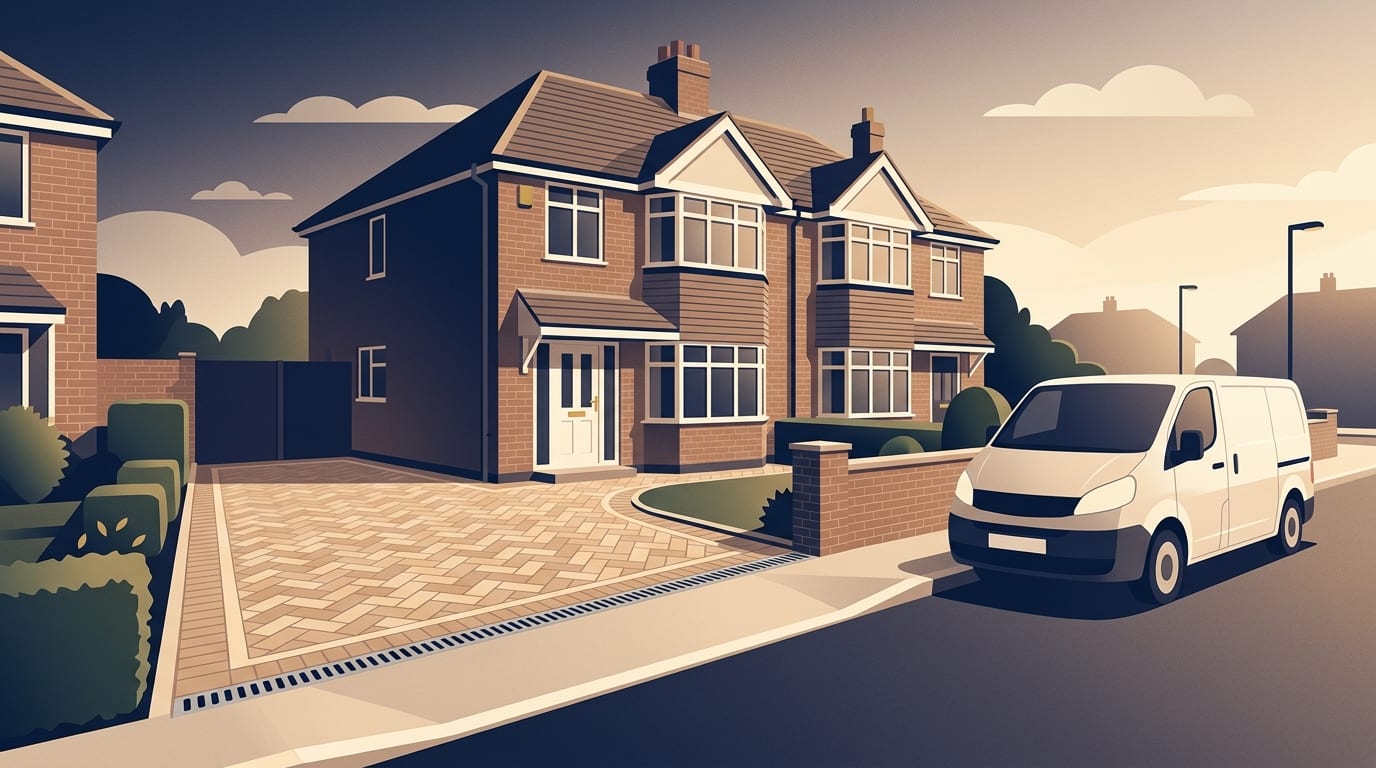
Block paving typically costs about £70 to £180 per square metre in 2026 depending on the block and on what the price includes, so a typical double driveway of about 40 square metres usually costs from around £2,800 to £8,500 depending on the blocks, the dig-out and the drainage, with London and the South East at the top. Some published rates include excavation, sub-base, edging and drainage and others are surface only, so totals and per square metre figures do not always match and you must compare like with like.
Typical block paving driveway prices
Block paving is a popular choice for a new driveway because it is durable and easy to repair. The final price you pay depends heavily on the type of block you choose and how much groundwork is required. The lowest prices are for standard concrete blocks laid on a simple replacement job, while the highest prices cover permeable blocks or premium clay brick paving with full excavation and new drainage.
You should always check whether a quote includes VAT. The spread between the highest and lowest quote for the exact same scope of work is routinely 25 to 40 per cent. Landscapers price per project after a site visit, and prices vary by location. London and the South East typically add 10 to 25 per cent to the cost. The regional range for standard blocks runs from £62 to £106 per square metre in Northern Ireland to £85 to £146 per square metre in London.
This table shows typical published prices for 2026, combining ranges that include full groundwork with those that are supply and lay only.
|
Block type |
Price per square metre |
|---|---|
|
Standard concrete blocks |
£70 to £120 |
|
Premium or clay blocks |
£90 to £160 |
|
Permeable block paving |
£85 to £180 |
These figures are typical guide prices for 2026. Local quotes will differ based on the exact scope of the work and the condition of your site.
Prices by driveway size
The total cost of your project is driven by the area to be covered and the access to your property. Everything carried through the house or moved by hand costs more. Driveways built on steep slopes or those that need extensive ground preparation will sit at the top of these price brackets. Steep or sloped driveways typically add 15 to 25 per cent to the bill.
This table shows typical published prices for 2026 across different driveway sizes, merged from published totals for installed driveways, most of which include the excavation, sub-base, edging and labour.
|
Driveway size |
Estimated total cost |
|---|---|
|
Single driveway (about 20 square metres) |
£2,000 to £4,500 |
|
Double driveway (about 40 square metres) |
£2,800 to £8,500 |
|
Large driveway (about 60 square metres) |
£4,500 to £12,000 |
|
Larger driveway (about 80 square metres) |
£7,000 to £13,000 |
These are typical published figures for 2026. Your local quotes will differ depending on how much old material needs to be dug out and taken away.
Concrete, clay and permeable blocks compared
Standard concrete blocks are the most common choice for a new driveway because they are affordable and easy to lay. Premium or textured concrete blocks cost slightly more but offer different finishes and colours. Clay brick paving is more expensive to buy and install but holds its colour well over the years.
Permeable block paving uses a different construction method to let rainwater drain straight through the surface. Government guidance on the permeable surfacing of front gardens explains that conventional driveways use a sub-base of hardcore or MOT Type 1. This contains fine material and is not permeable. A permeable driveway uses a sub-base with open voids, such as 4/20 or Type 3, rather than the usual compacted stone.
A permeable driveway normally has about 200 to 250mm of total construction. A geotextile layer is laid over the soil, followed by about 150mm of the compacted open-graded sub-base. The blocks are bedded on angular grit rather than sand. The surface uses wider joints filled with 2 to 6mm angular aggregate to let the water pass through.
Permeable systems need a knowledgeable contractor. Driveways steeper than 1 in 20 might not be suitable for permeable surfacing. Water should never be directed towards a neighbour's property, and on clay soils a pipe in the sub-base might be needed to drain water to the roof drains. When the work is finished, you can test it by running a hosepipe on the surface for one or two minutes. This should leave no puddles.
Government guidance warns that casual jobbing contractors who knock on your door offering to lay a driveway should not be used to build permeable driveways. It is best to use an experienced landscape or driveway contractor and get references.
What goes underneath
Hard landscaping is the built part of a garden, including patios, paths, walls, steps and driveways. Because a driveway carries heavy vehicles, it requires deep and stable groundwork. The groundwork nobody sees is where corners get cut. A thin or skipped sub-base is invisible on day one, but it is the main reason drives sink and rut over time. You should watch out for common poor practices, which include:
- Doorstep callers offering cheap paving or leftover materials.
- Cash deals with no written specification.
- A thin or missing sub-base beneath the blocks.
- No fall built into the surface, so water pools or runs towards the house.
A complete quote covers excavation to firm ground and spoil removal, followed by the correct sub-base. For a driveway carrying vehicles, the sub-base should be a compacted layer of at least 150mm of crushed stone, often called MOT Type 1. A sharp sand or grit laying course goes on top of the sub-base, and the blocks are laid onto this. Finally, kiln-dried sand is brushed into the joints and compacted to lock the surface together.
Groundwork adds significantly to the cost if it is priced separately from the surface materials. Excavation and muck-away costs £15 to £45 per square metre. Compacting 150mm of Type 1 sub-base costs £20 to £40 per square metre. If you are replacing an old surface, breaking out existing block paving costs £10 to £20 per square metre, while breaking out concrete or tarmac costs £20 to £40 per square metre.
Edging, patterns and drainage
A block paving driveway needs strong edges to stop the blocks spreading under the weight of a car. These edge restraints are usually concrete kerbs or a block soldier course set into concrete, known as concrete haunching. Concrete kerbs cost £15 to £30 per metre, while a block soldier course costs £20 to £35 per metre. Concrete haunching to hold the edging in place costs £15 to £25 per metre.
The pattern you choose affects the labour cost. A herringbone pattern uses more cuts at the edges and takes more labour to lay than a simple stretcher bond pattern. A two-person crew can lay 40 to 60 square metres of blocks a day on a clear site, but complex patterns will slow this down.
A driveway must be built with a slight slope, known as a fall, to shed water away from your house. To manage this water legally, you will often need extra drainage. Adding drainage that meets the front garden rules typically costs £600 to £1,500. A channel drain installed across the threshold costs £60 to £120 per metre. A trapped gully costs £150 to £250. If you are comparing different surfaces, you might want to look at how much a resin driveway costs before you make a final decision.
Planning rules for front driveways
In England, you will not need planning permission if a new or replacement driveway of any size uses permeable or porous surfacing. This includes permeable concrete block paving, porous asphalt or gravel. You also do not need permission if the rainwater is directed to a lawn or border to drain naturally.
If the surface to be covered is more than five square metres, traditional impermeable driveways that do not let the water run to a permeable area need planning permission. These allowances apply to houses, not flats or maisonettes. They can also be removed by a planning condition or an Article 4 Direction, so you should check with your local council if you are unsure. You can read the full rules on paving your front garden on the Planning Portal.
To drive over a pavement onto your property you need a dropped kerb. It is illegal to drive over a pavement without one. You have to make a dropped kerb application to your local authority, which can tell you its process and any charges.
How long the work takes
Block paving takes three to five days to lay for a typical 40 square metre double driveway. The exact duration depends on how much excavation is needed, how deep the sub-base must be, and whether you are adding new drainage or complex patterns.
The work usually starts with breaking out the old surface and digging down to firm ground, then laying and compacting the sub-base and setting the edge restraints in concrete. The sharp sand laying course and the blocks come next, and the job finishes with cutting the edge blocks to size, brushing in the kiln-dried sand and compacting the surface.
Looking after block paving
Block paving requires some upkeep to stop weeds growing in the joints and to keep the surface stable. Individual blocks can be lifted and relaid if they sink or get damaged, which costs £30 to £80 per square metre.
Cleaning the driveway with a pressure wash costs £120 to £300 for a typical 40 to 60 square metre area, which works out at £3 to £6 per square metre. Washing strips the joint sand, which must be replaced. Skipping the re-sand leaves the joints empty, which loosens blocks over time and allows weeds to take root. Re-sanding block paving joints after washing adds £200 to £500, or £5 to £10 per square metre.
Sealing block paving is optional but helps protect the surface from stains. Sealing adds £150 to £400, or £3 to £8 per square metre. A full clean, re-sand and seal costs £300 to £700 and is typically done every three to five years. You can read more about how to clean a patio or driveway without damaging it to keep the surface looking sharp.
Common questions
How much does a new driveway cost?
One 2026 comparison for a 60 square metre drive puts block paving at £4,500 to £7,500, imprinted concrete at £6,200 to £8,000, resin at £3,500 to £5,500, tarmac at £2,500 to £5,000 and gravel at £2,500 to £4,200. Other published all-in prices for a block paved drive of this size go up to £12,000, as the table above shows.
Does a block paved patio cost the same as a driveway?
A block paved patio of 25 square metres typically costs £2,000 to £3,800. A patio does not need to carry the weight of a car, so the sub-base can be thinner than the 150mm required for a driveway. This reduces the material costs, but poor access to a back garden can push the labour price back up.
Can sunken block paving be repaired?
Individual blocks can be lifted and relaid to fix sunken areas or ruts, which costs £30 to £80 per square metre. The contractor will need to fix the sub-base underneath before replacing the blocks and brushing in new sand.
What is the difference between a garden designer and a landscaper?
A garden designer produces the plan for your outdoor space, while a landscaper or landscape contractor builds it. Once the hard landscaping is finished and the planting is done, a gardener maintains it.
What a block paving quote should include
A good quote states exactly what materials will be used and how deep the hidden groundwork will be. Landscapers price per project after a site visit, and you should ask for a written quote rather than an estimate. A quote is a fixed price, while an estimate is a rough guess and you might end up paying more.
Your written specification should include:
- The total area to be paved and the excavation depth.
- The sub-base type and depth, which should be at least 150mm of MOT Type 1 for vehicles.
- The exact block type, colour, laying pattern and edge restraints.
- The drainage system and whether the construction is permeable.
- Spoil removal by a registered waste carrier.
- The start date, expected duration and payment stages.
- The details of the guarantee provided for the installation.
A trader who carries waste must be a registered waste carrier. A business that transports waste can get an unlimited fine if it does not register. Registered businesses appear on the public register of waste carriers, brokers and dealers, which you can check online.
Your next steps
Before you hire a landscaper, make sure you know exactly what you are paying for and what protections you have. Under the Consumer Rights Act 2015, work must be done with reasonable care and skill. If it is not, you can ask for it to be put right or seek a partial or full refund.
- Decide whether you want standard, premium or permeable blocks before asking for prices.
- Get written quotes from at least three different traders to compare the groundwork.
- Ask for two or three recent examples of similar work and the contact details of those customers.
- Check the trader's insurance and your own buildings insurance.
- Get a written contract covering everything agreed, such as timings, tidying up, materials and payments.
- Pay by card rather than cash, pay in stages, and avoid deposits of more than 25 per cent.
You might be able to cancel within 14 days of telling the trader you want the work done or signing a written contract, according to advice on building work from Citizens Advice.
Landscaping is not a licensed trade, so vetted membership of a trade body is a good sign, though not a guarantee. The British Association of Landscape Industries (BALI) says its Accredited members are vetted on workmanship, skill and health and safety. The Association of Professional Landscapers (APL) says members are assessed, regularly inspected and TrustMark accredited. TrustMark is the government-endorsed quality scheme. When you are ready to start gathering quotes, you can find a landscaper near you to discuss your driveway project.
Related Guides
How Much Does a Retaining Wall Cost and Which Type Is Best?
Typical UK retaining wall prices for sleepers, block, brick, stone and gabions, when you need an engineer, why drainage matters and what a quote should include.
How Much Does a Gardener Cost for Regular Garden Maintenance?
Typical UK gardener rates per hour, per visit and per year, what regular garden maintenance covers, what costs extra and how to check a gardener first.
How Much Does a Brick Garden Wall Cost?
Typical UK prices for brick and rendered block garden walls per metre, what foundations, piers and coping add, height and party wall rules, and signs of an unsafe wall.