If you are planning a new or replacement driveway, the rainwater that lands on it must be managed properly. In England the planning rules for paving a front garden turn on how that water drains, so the surface and the drainage plan are decided together.
The front garden rule in England
You must follow specific regulations when paving over a front garden. The rule for England, as the Planning Portal words it, is that no planning permission is needed for a new or replacement driveway of any size that uses permeable or porous surfacing, such as gravel, permeable concrete block paving or porous asphalt, or if the rainwater is directed to a lawn or border to drain naturally. If the surface to be covered is more than five square metres, planning permission will be needed for a traditional impermeable surface that does not drain that way.
This is the official guidance for England. The policy in Wales may differ. These permitted development rights apply to houses, not flats or maisonettes. Areas where there is a planning condition, an Article 4 Direction or another local restriction will also have different rules. You should always check with your local council if you are unsure.
The GOV.UK guidance on permeable front gardens makes the exact same point and covers permeable surfaces, soakaways and rain gardens for controlling rainfall run-off into drains. You can read the full official wording for yourself on the Planning Portal.
Permeable surfaces and what sits under them
Hard landscaping is the built part of a garden, which includes your driveway, patios, paths, walls, steps, fencing, drainage and decking. Soft landscaping is the living part, such as soil, turf, planting and trees. A garden designer produces the plan for these areas, a landscaper or landscape contractor builds it, and a gardener maintains it.
According to the RHS, gravel is by far the cheapest permeable option for a driveway. Brick pavers are another option, which let water through small gaps between the blocks. The required permeable sub-base for these bricks will affect what block paving costs. Matrix pavers are recycled plastic cells filled with aggregate that provide a stable surface. Grass reinforcement is also used to strengthen lawns so they can handle the weight of vehicles.
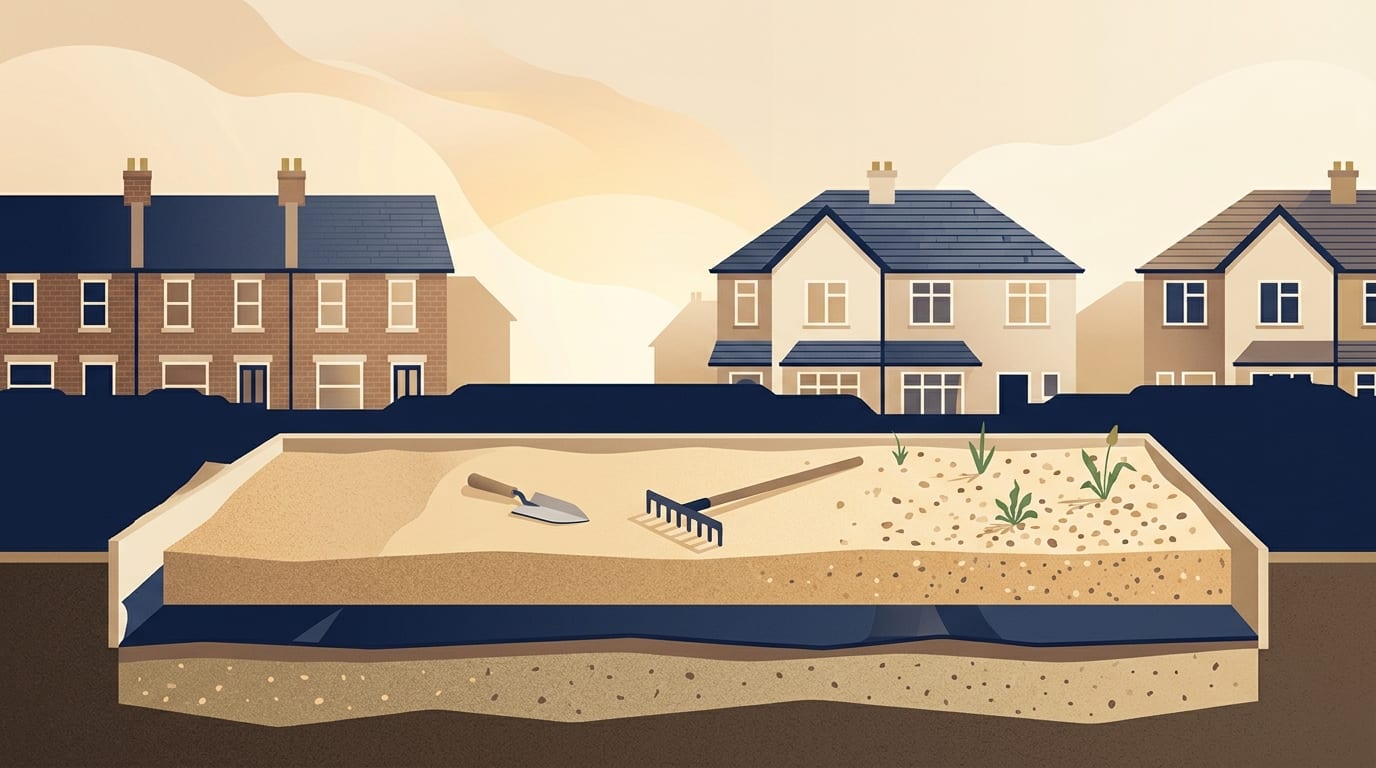
For any of these surfaces to work, the foundation beneath them must also be permeable. This foundation is called the sub-base. A standard sub-base is made of compacted crushed stone, often called MOT Type 1, which is commonly used under regular paving and artificial grass. A standard MOT Type 1 sub-base compacts tightly, so check that the foundation quoted for a permeable surface is itself permeable.
If you are laying a permeable driveway, the brick pavers must sit on compacted aggregate. The hardcore foundation is also permeable so that water can soak away. If the foundation does not let water through, the water may have nowhere to go and the driveway can hold puddles.
Draining to a lawn or border
If you choose to lay a traditional impermeable surface, the rainwater will not be able to soak through it. The RHS warns that non-porous hard landscaping can increase rainwater run-off by as much as 50 per cent, often causing flooding.
The RHS advises allowing driveways to drain into borders, and the Planning Portal says planning permission is not needed where rainwater is directed to a lawn or border to drain naturally. A landscaper can do this by building a slight slope into the surface. This slope is called a fall, and it sheds water in a specific direction. The fall directs the rainwater away from your house brickwork and off the driveway so that it runs into a lawn or planting border, where it can drain naturally into the soil.
Channel drains and soakaways
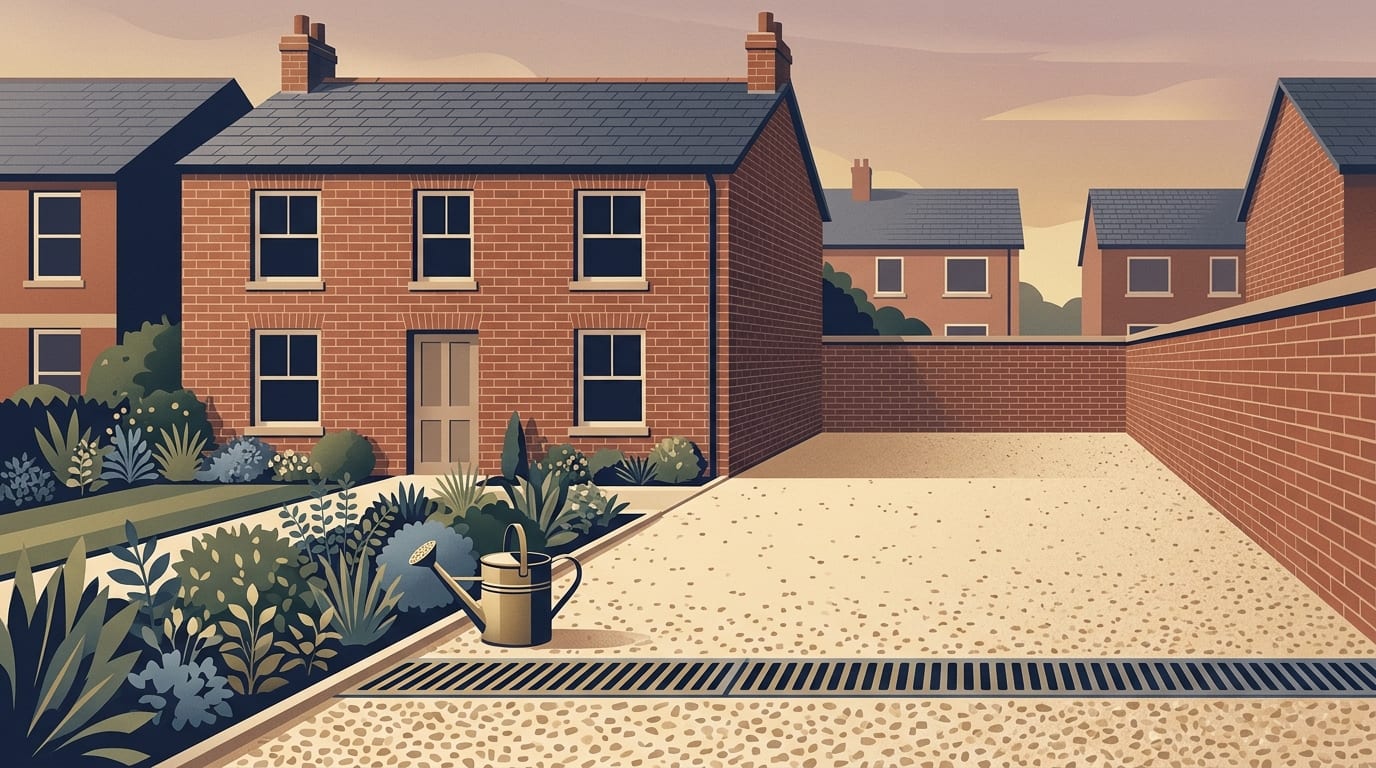
If your driveway slopes towards your house or towards the public road, and you cannot direct the rainwater to a lawn or border, you will need a drainage system. A channel drain is a long trench covered by a metal or plastic grate that sits flush with the driveway surface. It catches the surface water before it can pool against your walls or run out onto the pavement.
The channel drain then pipes this water underground into a soakaway. A soakaway is a pit in the ground that stores rainwater and lets it drain slowly into the surrounding soil. For another way of moving water away from a garden, see building a French drain.
Soakaway sizing uses a percolation test and BRE Digest 365, which measure how quickly your soil drains. The final size of the soakaway allows for a one-in-ten-year storm plus a safety margin. If your garden has heavy clay soil, the water will drain very slowly. Heavy clay needs a much larger pit or a slow-release outfall to handle the volume of water.
Soakaways should normally be placed at least five metres from any building and at least five metres from a road. In England and Wales, drainage carrying rainwater from the house roof to a soakaway needs Building Control approval. A soakaway serving only a driveway or patio usually does not need Building Control approval. Rules vary across the UK, so you should check with your council planning department before work begins.
What drainage options typically cost
Landscapers price per project after completing a site visit. The main cost drivers for a new driveway are the total area, the groundwork required, the changing levels of the site, access, waste removal, drainage requirements and the materials you choose. Everything that has to be carried through a house costs more.
Drainage estimates for a driveway come in two sets for 2026. Typical prices put channel drain materials at £15 to £60 per metre, with the channel drain labour costing £250 to £600 or more. A professional percolation test is typically £150 to £300. For the soakaway itself, a typical medium domestic soakaway averages about £850, while smaller units start from £660. Driveway soakaways are often larger, estimated at £1,000 to £1,200 or more. For a 60 square metre drive, an initial soakaway cost is estimated at £850 to £1,100.
The table below shows a second set of figures for the same type of work. They were compiled differently, so the two sets should not be combined.
|
Drainage job |
Typical 2026 price |
|---|---|
|
Linear channel drain fitted per metre |
£40 to £80 |
|
Typical 4 to 6-metre channel run |
£200 to £500 |
|
Directing fall to a permeable border |
£150 to £600 |
|
Complete soakaway installation range |
£600 to £1,500 |
These are typical guide figures for 2026, and you should always check whether your local quotes include VAT. Estimates vary: some 2026 price lists put a soakaway at about £850, others at £600 to £1,500.
What goes wrong with driveway drainage
The groundwork nobody sees is where corners get cut. A poorly built driveway will fail quickly, and poor drainage will cause lasting damage to your property.
A common problem is doorstep callers offering cheap paving or leftover materials from another job. These are often cash deals with no written specification, leaving you with no proof of what was agreed. Another issue is a thin or missing sub-base, which can let the driveway sink. Some rogue traders lay paving slabs on small dabs of mortar instead of a full bed, which can leave empty voids where water gathers.
If the landscaper builds the driveway with no fall, the surface water will pool in the middle or, worse, run directly towards your house and cause damp problems in your masonry. Just as a flat surface is why water pools on your patio, a poorly levelled driveway will hold puddles that freeze in winter. Another frequent mistake is artificial grass laid straight onto soil, which is a common fault.
Questions to ask a landscaper about drainage
A good quote states the exact excavation depth, the sub-base depth, named materials, the drainage plan and the cost of waste removal. You should ask the landscaper specific questions about how they will manage the water.
- Which surface and sub-base materials are you quoting for?
- Where exactly will the surface water go?
- Does the fall direction slope safely away from the house?
- Who is responsible for sizing the soakaway?
- Is a percolation test included in the price?
Landscaping is not a licensed trade, so vetted membership and evidence of past work matter. The British Association of Landscape Industries (BALI) says its Accredited members are vetted on workmanship, skill and health and safety. The Association of Professional Landscapers (APL) says members are assessed, regularly inspected and TrustMark accredited. TrustMark is the government-endorsed quality scheme. Membership of these bodies is a good sign, not a guarantee.
If your project involves design work, you might hire a garden designer. The Society of Garden and Landscape Designers (SGLD, formerly the Society of Garden Designers) is the professional body for designers.
Rules and consumer protections
Any trader who carries waste away from your property must be a registered waste carrier, and this register is public so you can check their credentials online. Check the register before you hand over any old driveway rubble.
If your new driveway requires working near large trees, you must be careful. A Tree Preservation Order makes it an offence to cut down, lop, uproot or damage a protected tree without the council's consent. Work on trees in a conservation area normally needs six weeks' notice to the council.
If your driveway project is part of a larger garden redesign, other planning rules apply. In England, decking is permitted development if it is no more than 30cm above the ground and, together with extensions and outbuildings, covers no more than 50 per cent of the garden. Fences and walls can be up to 1 metre high next to a road or its footpath and 2 metres elsewhere. Check with your council if you are unsure.
Under the Consumer Rights Act 2015, all landscaping work must be done with reasonable care and skill. If it is not, the customer can ask for it to be put right or seek a partial or full refund. A quote is a fixed price, whereas an estimate is a rough guess. Citizens Advice suggests getting three written quotes, securing a written contract, paying deposits of no more than 25 per cent and paying by card. They also note that you might be able to cancel within 14 days of agreeing a contract. If you end up in a dispute, Citizens Advice is the best place to go for guidance.
Common questions
Do I need a drainage channel for a new driveway?
A channel drain is usually considered for a solid driveway where water would otherwise run onto the road. In England, an impermeable surface of more than five square metres that does not drain to a permeable area needs planning permission. A channel drain feeding a soakaway is the usual way to handle water from a solid driveway that would otherwise run onto the road, so ask your landscaper and check with your council.
What makes a driveway permeable?
A driveway is permeable if both the top surface and the sub-base beneath it allow water to pass through into the ground. Gravel, porous asphalt and specialized block paving are permeable surfaces, but the foundation beneath them must also be permeable.
How does a percolation test work?
A percolation test measures how quickly water drains away into your specific garden soil. The result is used to size the soakaway, so ask who carries it out and whether it is included in the price.
Can I drain my driveway onto the pavement?
The planning rule for England is framed around surfaces that let water through or drain to a lawn or border. Ask your landscaper exactly where the water will go, and check with your council before choosing a design that sends it towards the road.
Next steps before you agree a design
Before you commit to a contractor and pay a deposit, you should make sure every detail is confirmed in writing.
- Check whether your chosen surface requires planning permission based on the front garden rules.
- Confirm that the quote includes a permeable sub-base if you are paying for a permeable surface.
- Ask the landscaper to explain their drainage plan and point out exactly where the fall will direct the water.
- Verify that the trader is a registered waste carrier if they are removing your old driveway.
- Ask for proof of a percolation test if a soakaway is being quoted.
Taking the time to understand the drainage plan protects your property from flooding and damp walls. When you are ready to get written quotes for the work, you can find a landscaper near you to assess your site and explain your options.
Find a top rated landscaper near you
4,373 landscapers across the UK, each ranked on their Google rating and the number of reviews behind it. Start with your county: