
How Much Does a Retaining Wall Cost and Which Type Is Best?
TopRatedLandscapers.co.uk · 7 October 2026
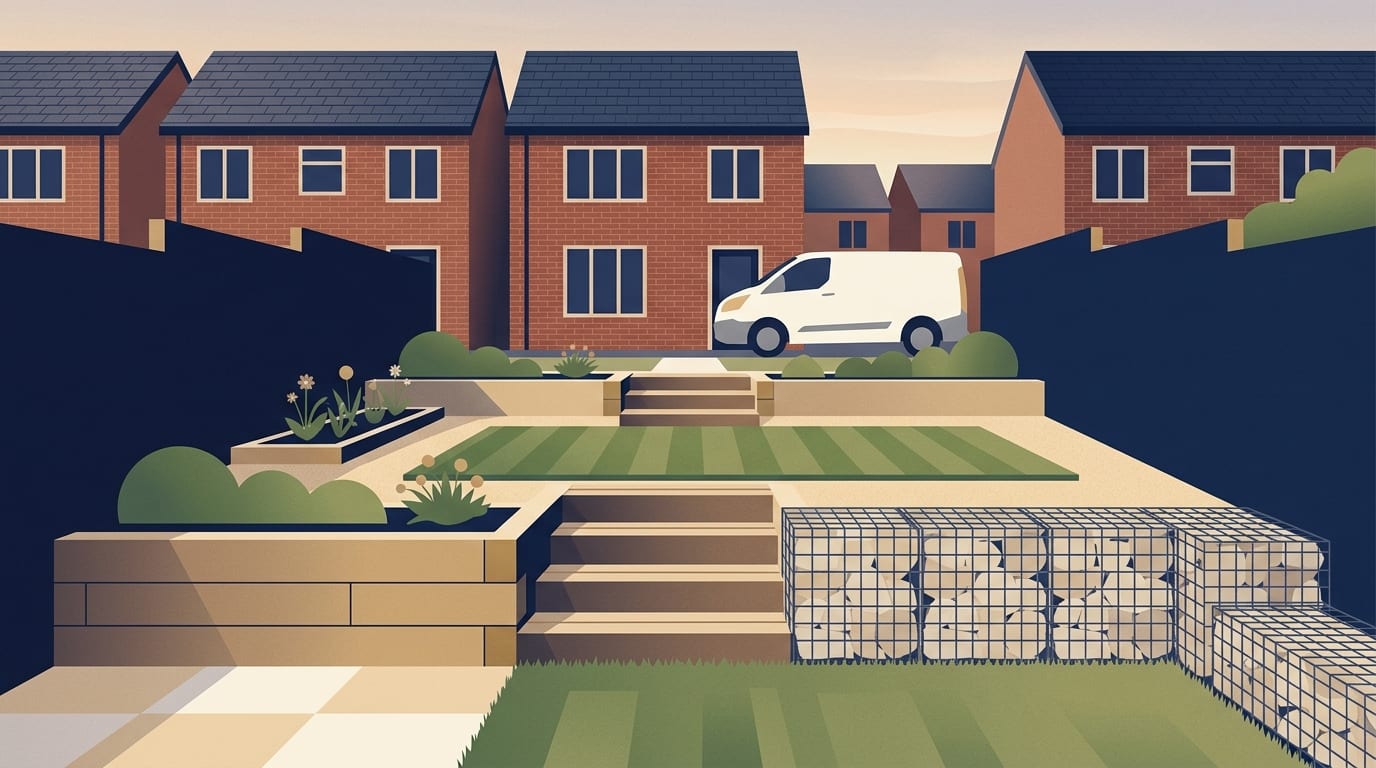
Most garden retaining walls cost roughly £100 to £500 per square metre of wall face in 2026 depending on the material. Retained height matters more than anything because above about 1 to 1.2 metres, or wherever the wall holds up a drive, a building or a neighbour's ground, it needs a structural engineer's design.
What a retaining wall does
Unlike a standard freestanding garden wall, a retaining wall holds back a bank of earth. If you have a sloping garden and want to create flat, usable terraces, a retaining wall holds the higher ground in place so it does not collapse into the lower area. You will often see them used when figuring out how to level a sloping garden.
Because a retaining wall has to resist the immense weight of wet soil pushing against it, it is a major piece of hard landscaping (the built part of a garden, rather than the soft landscaping of soil and plants).
The price of a retaining wall is quoted per square metre of wall face. This simply means the height of the wall multiplied by its length. A wall that is 10 metres long and 1 metre high has a face of 10 square metres.
The groundwork nobody sees is where corners get cut. Without adequate drainage, water pressure builds up behind the masonry, and water pressure pushes more walls over than the soil itself.
Typical retaining wall prices
Quotes for a retaining wall vary widely because some published rates include the foundations and drainage, while others exclude excavation, muck-away and groundwork. You must read a quote line by line to understand exactly what the landscaper has priced.
As a worked example, a 10-metre long, 1 metre high reinforced, rendered concrete block retaining wall with full drainage came to a £7,000 quote excluding VAT. That works out at roughly £700 per square metre all-in, which shows how far a fully finished price can sit above a basic headline rate.
The table below shows typical published prices for different wall materials built in 2026. These figures include the foundations and the drainage behind the wall, except for reinforced concrete which excludes groundworks.
This table compares the typical costs and characteristics of common retaining wall materials.
|
Wall type |
Typical price per square metre of wall face |
Notes |
|---|---|---|
|
Timber sleeper |
£100 to £250 |
Fastest and cheapest to build, suits heights up to 1 metre, 15 to 25-year lifespan. |
|
Gabion baskets |
£150 to £300 |
Drains itself naturally, suits stepped walls up to 2 metres, can last 50 years. |
|
Rendered concrete block |
£200 to £400 |
The standard structural build for most domestic gardens. |
|
Brick matching the house |
£250 to £450 |
Premium finish, needs an engineered core if over about 1 metre high. |
|
Natural stone faced |
£250 to £450 |
High material cost, needs an engineered core if over about 1 metre high. |
|
Reinforced concrete |
£250 to £450 |
Excludes excavation and drainage. A heavy-duty structural option. |
These are typical published guide prices for 2026. Local quotes will differ, and prices in London run about 25 to 30 per cent above the Midlands baseline.
Sleepers, block, brick, stone and gabions compared
Choosing the right material depends on the height of the bank and how long you want the wall to last, so discuss the options with the landscaper pricing the job.
Timber sleepers are the fastest and cheapest option. A sleeper wall suits low retaining work up to around 1 metre high. You should choose new oak or treated softwood sleepers rather than old railway sleepers. Life-expired railway sleepers can leach creosote. Treated softwood sleepers have a finite life of 15 to 25 years before they begin to rot.
Gabions are wire baskets filled with quarried stone. A standard gabion wall with quarried stone fill costs £120 to £250 per square metre supplied and built, while decorative hand-packed faces cost £250 to £350. Because they are essentially cages of rocks, gabions are entirely free-draining, meaning no water pressure builds up behind them. With coated cages and durable stone, a gabion wall can last 50 years or more.
Rendered or faced concrete block is the standard structural build for most garden walls. It provides a sheer, flat face that can be painted or covered with decorative tiles.
Brick and natural stone cost the most because the materials are expensive and they take longer to lay. If a brick or stone wall needs to hold back more than about 1 metre of earth, the visible masonry is usually just a decorative skin built in front of an engineered concrete block core. If you are building a boundary divider rather than holding back soil, you can check how much a brick garden wall costs instead.
Why height changes everything
The height of a retaining wall dictates exactly how it must be built. A wall holding back 40 centimetres of soil for a raised flower bed requires entirely different construction to a wall holding back 1.5 metres of sloping lawn.
Low gabion walls often need only a level, compacted base. A modest gabion retaining wall of 6 to 8 linear metres typically takes a two-person team two to four days, depending on access.
Past about a metre of retained height, the forces acting on the masonry multiply. This is why tall sleeper walls can lean forward over time, and thin brick walls can crack. Wherever a wall holds up a driveway, a building or another property, the extra weight above the wall is called a surcharge load, and the wall needs an engineer's design to carry it.
When you need a structural engineer
Anything over roughly 1 to 1.2 metres of retained height needs a structural engineer's design. The same rule applies to shorter walls that support a structure, a driveway or a neighbour's garden.
An engineer calculates the precise depth of the foundations, the thickness of the blockwork, and the amount of steel reinforcement required to stop the wall failing. This design fee is typically £400 to £1,200 for a domestic wall.
The Planning Portal advises getting expert advice if a wall exceeds the recommended height for its thickness, or for walls retaining soil. Walls must be structurally sound and maintained, as garden and boundary walls are amongst the most common forms of masonry to suffer collapse, and one of the most common causes of death by falling masonry. Your home insurance may not cover you if a wall has been neglected.
Your engineer or your local council building control department can confirm whether your specific tall or loaded wall needs formal building regulations approval before work begins.
Drainage behind the wall
Most retaining wall failures are drainage failures. When it rains, soil absorbs water and becomes significantly heavier. If that water cannot escape, it acts like a hydraulic press against the back of the masonry.
Proper drainage involves several layers built directly behind the wall. The landscaper will lay a perforated land drain at the base, which must be laid to a slight fall (the slight downward slope that sheds water) so water runs towards a soakaway or a surface water drain.
Above the pipe, the gap between the earth bank and the back of the wall is filled with free-draining gravel. This gravel is wrapped in a geotextile membrane to stop wet soil washing into the stones and clogging the pipe. Finally, the wall itself should have weep holes at the base every 1 to 1.5 metres to let trapped water escape through the face of the masonry. Because of the sheer weight of soil and water involved, a structural retaining wall is never a job for a lay person to attempt.
What pushes the price up
The final price of your project depends heavily on the groundwork required before the first brick is laid.
Foundations and footings cost £80 to £300 per linear metre. A tall wall needs a deep, wide concrete trench to stop it tipping forward, which means a large volume of heavy concrete to mix and pour.
Labour day rates for a bricklayer or an experienced groundworker range from £180 to £300 per day. Access to your garden dictates how fast they can work. If all the excavated soil, wet concrete and heavy blocks have to be carried in wheelbarrows through your house, the job will take much longer. Poor access for stone delivery increases labour costs significantly.
Getting rid of the excavated soil is a major expense. Access for a muck-away lorry adds £200 to £800 to the bill. Any business that transports your waste must be a registered waste carrier, and you can check them on the public register. A trader can get an unlimited fine if they are not registered.
Planning, boundaries and party walls
You do not normally need planning permission to put up, alter or take down a wall if it is no more than 1 metre high next to a highway used by vehicles, or its footpath. Elsewhere, walls up to 2 metres high are permitted development.
These rights do not apply if your property is a listed building, if the boundary is with a listed building, or if the right has been removed by an article 4 direction or a planning condition. In a conservation area, you might need permission to take down an existing wall. This guidance is for England, and Wales may differ, so check with your local council if you are unsure or live elsewhere.
In England and Wales, if you want to build on or at the boundary of your two properties, work on an existing party wall, or dig below and near to the foundation level of a neighbour's property, you must give them written notice under the Party Wall Act.
This notice must be given between two months and a year before work starts. The neighbour has 14 days to reply in writing, and no response cannot be taken as agreement. If you cannot agree, surveyors draw up a party wall award. Boundary retaining walls between properties are a legal grey zone, so you should agree in writing whose wall it is before work begins.
What a retaining wall quote should include
A professional quote is a fixed price. An estimate is just a rough guess, so you might end up paying more. Under the Consumer Rights Act 2015, work must be done with reasonable care and skill. If it is not, you can ask for it to be put right or seek a partial or full refund.
Citizens Advice suggests getting written quotes from at least three different traders. A detailed landscaping quote should list:
- The chosen wall type and the exact retained height.
- The width and depth of the concrete foundation.
- The structural engineer's design fee, where the height requires it.
- All drainage items, including the membrane, gravel, land drain and weep holes.
- The backfill material used behind the wall.
- The coping stones or finish for the top and face of the wall.
- Spoil removal by a registered waste carrier.
- A written agreement on who owns the wall, if it sits on a boundary.
Citizens Advice recommends getting a written contract, paying by card rather than cash, and paying in stages. Avoid upfront deposits, and do not agree to more than 25 per cent if a deposit cannot be avoided. You might be able to cancel within 14 days of telling the trader you want the work done or signing a written contract.
Common questions
What is a gabion retaining wall?
A gabion wall is built by stacking wire mesh baskets and filling them tightly with heavy quarried stone. Because the baskets are full of gaps, water drains straight through them, which stops dangerous water pressure building up behind the wall. At a cost of £200 to £400 per linear metre for a wall 1 metre high and 1 metre deep, they are a highly durable option that can last for decades.
Are railway sleepers good for retaining walls?
Sleepers are excellent for low retaining walls up to about 1 metre high, but you should use new oak or treated softwood rather than old railway sleepers. Reclaimed railway sleepers can leach creosote. While they are the fastest and cheapest material to build with, treated softwood sleepers have a finite lifespan of 15 to 25 years before they rot.
How deep should retaining wall foundations be?
The depth of the foundations depends entirely on the height of the wall and the weight of the soil it holds back. Low gabion walls often need only a compacted crushed stone base, while a tall concrete block wall requires a deep, wide trench filled with reinforced concrete. If the wall holds back more than a metre of earth, a structural engineer must calculate the exact foundation depth required.
Can I build a cheap retaining wall?
Timber sleepers are the most affordable option, costing £100 to £250 per square metre of wall face built. However, a cheap quote for a masonry wall is often a warning sign that the landscaper has skipped the necessary groundwork. A wall built on a shallow foundation with no drainage behind it can crack and tip forward under the weight of wet soil.
What to do next
Before you hire a landscaper to build a retaining wall, make sure you have the key details written down.
- Measure the height of the bank you need to hold back to see if it crosses the 1 metre threshold for an engineer's design.
- Check whether the high ground supports a driveway, an outbuilding or a neighbour's garden, which adds a surcharge load.
- Decide between a long-lasting masonry or gabion wall, or a cheaper timber sleeper wall with a shorter lifespan.
- Talk to your neighbour early if the wall sits on the boundary or requires digging near their foundations.
- Ask at least three landscapers for a fixed written quote that breaks down the foundation size, the drainage plan and the waste removal costs.
When you are ready to start gathering quotes, you can find a landscaper near you to inspect the site and offer professional advice.
Related Guides

How Much Does a Gardener Cost for Regular Garden Maintenance?
Typical UK gardener rates per hour, per visit and per year, what regular garden maintenance covers, what costs extra and how to check a gardener first.
How Much Does a Block Paving Driveway Cost?
Typical UK block paving driveway prices per square metre and by drive size, what goes underneath, permeable paving and the front garden rules, and what to ask.
How Much Does a Brick Garden Wall Cost?
Typical UK prices for brick and rendered block garden walls per metre, what foundations, piers and coping add, height and party wall rules, and signs of an unsafe wall.