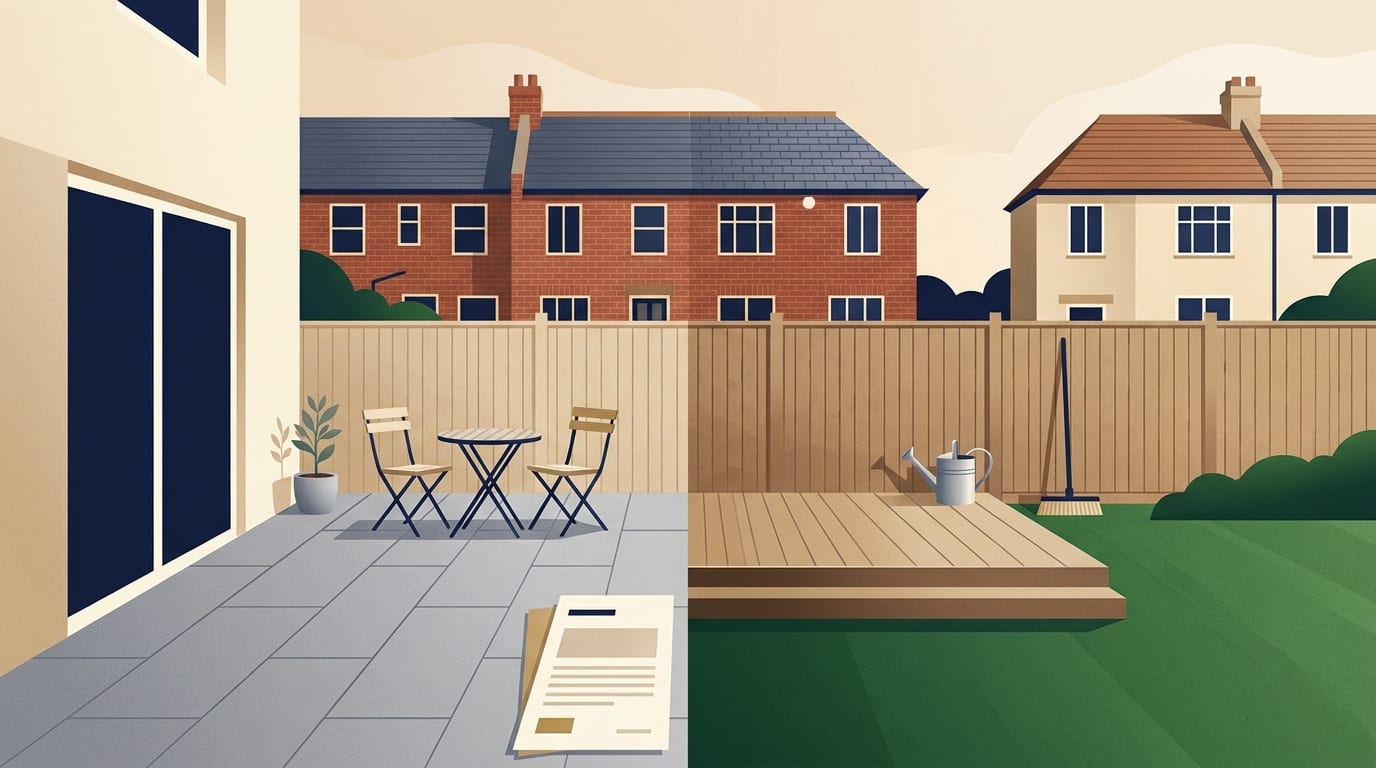
Neither a patio nor decking is better for everyone. A patio usually needs less upkeep and lasts longer, while decking can suit sloping ground and has a warm look, but it needs more care. Your choice will come down to how you plan to use the space, the shape of your garden, and how much time you want to spend maintaining it. This guide explains the costs, the rules, and how to choose the right surface for your project.
Patio or decking at a glance
When you plan a new outdoor space, you are dealing with two sides of the trade. Hard landscaping is the built part of a garden. This includes patios, paths, walls, steps, decking, fencing and drainage. Soft landscaping is the living part, which covers soil, turf, planting and trees. A patio and decking both fall under hard landscaping, but they are built in very different ways.
A patio is built from the ground up. A landscaper will dig out the soil and lay a sub-base. This is a layer of compacted crushed stone, often called MOT Type 1, that sits under paving and artificial grass to provide a solid foundation. The slabs are then laid on top of a full bed of mortar. This creates a solid, heavy surface that sits flush with the ground or slightly above it.
Decking is built above the ground. It consists of a frame made of timber joists beneath the boards. The frame holds the boards above the ground. The boards themselves can be softwood, hardwood or composite. Softwood is the cheapest of the three, hardwood costs more and lasts longer, and composite is a manufactured board that needs no treatment.
What each costs
The table below shows typical installed costs per square metre for different patio and decking materials.
|
Material |
Typical installed cost per square metre |
|---|---|
|
Concrete slabs |
70 to 110 pounds |
|
Softwood decking |
80 to 140 pounds |
|
Sandstone |
90 to 140 pounds |
|
Porcelain |
120 to 180 pounds |
|
Composite decking |
120 to 220 pounds |
|
Hardwood decking |
140 to 220 pounds |
These are typical 2026 guide figures, and local quotes will differ.
Separate 2026 figures put a standard 20 square metre patio at 900 to 2,500 pounds. The two sets of figures were worked out differently, so read them separately. The separate figures also say budget timber decking is often cheaper to install than a patio, especially on sloping ground. The material you choose is only one part of the bill. The main cost drivers are the area, the groundwork, the levels, the access, waste removal, drainage and materials. The groundwork nobody sees is where corners get cut, so a cheap quote might mean missing sub-base.
Access is a major factor for garden work. Everything carried through the house costs more because it takes longer and requires more care to protect your floors and walls. If you live in a terraced house with no rear access, the landscaper must bring all the crushed stone in and take all the excavated soil out through your front door.
Waste removal also adds a significant amount to the price. Digging out a patio creates a large volume of heavy soil that must be taken away. A trader who carries waste must be a registered waste carrier, and the register is public. Always check this before they start the job.
Location plays a part too. London and the South East cost more than other parts of the country. When you compare your quotes, check whether VAT is included in the final figure. A quote is a fixed price, while an estimate is just a rough guess. Larger jobs are normally paid in stages.
How long each lasts
A professionally laid patio can last several decades. Unlike timber, paving does not rot. How long a patio lasts depends heavily on the quality of the groundwork. If the sub-base is deep enough and the mortar is mixed correctly, the paving will stay flat and stable for years.
Decking has a shorter lifespan, and this depends heavily on the boards you choose. Softwood decking generally has a lifespan of 10 to 15 years. Cheaper boards of any kind may last only 10 to 15 years before they need replacing. Hardwood decking is much tougher and typically lasts 20 to 25 years. Composite decking is the most durable option, lasting 25 years or more, and requires no treatment.
When you build a deck, the frame beneath the boards must also stand the test of time. Even with long-lasting boards, the frame beneath them matters. A timber frame that sits in damp ground or has poor drainage can rot before the boards do.
Under the Consumer Rights Act 2015, all work must be done with reasonable care and skill. If it is not, the customer can ask for it to be put right or seek a partial or full refund. If your new patio sinks after a few months because the sub-base was missing, you can ask for the work to be put right.
Upkeep compared
A patio needs less upkeep than decking. To keep paving looking good, you just need routine patio brushing and occasional weed treatment. Over time, dirt and moss can build up on the slabs. Professional jet washing costs 150 to 400 pounds.
You can also protect paving with a surface sealant, which costs 3 to 6 pounds per square metre and needs redoing over time. The mortar joints between the slabs can eventually crack or wash away due to frost and weathering. If this happens, repointing costs 20 pounds per square metre.
Decking needs ongoing maintenance to prevent rot and wear. You must wash timber decking every few months to prevent algae and moss that can make boards slippery. Oiling every year or two is a good idea for timber to protect it from the weather.
You should inspect the joists and fixings periodically, especially on decks over 7 to 10 years old. Checking the frame ensures the structure remains safe to walk on. Composite needs significantly less maintenance than timber, with a simple hose down usually being enough. It may need occasional clearing of surface algae in damp or shaded areas.
Slippery surfaces in wet weather
A major concern for many people is how slippery the surface will get. Decking can be very slippery in wet weather and winter, and algae and moss on timber boards make it worse. Washing timber decking regularly helps to keep it from getting slippery.
Patios can also get slippery with algae in damp, shaded spots. A landscaper can suggest textured finishes for your paving if your garden is heavily shaded or prone to damp. Neither surface is completely slip-proof, so keeping them clean is essential.
Sloping and uneven gardens
If your garden has a steep slope, levelling it for a patio can be a big job. The landscaper may have to excavate soil and bring in extra sub-base, and a steep slope can also call for retaining walls. Retaining walls that hold back soil are structural work, so they need proper design and a specialist. This groundwork can push the price up.
This is why budget timber decking is often cheaper to install than a patio, especially on sloping ground. A timber frame can be built to create a level deck above the slope, which can reduce the groundwork. How much it saves depends on your garden, so ask each landscaper to price the groundwork separately.
Whether you choose a patio or decking, the surface must have falls. A fall is the slight slope that sheds water. Without a fall, rainwater will sit on the surface. A bad landscaper might build a patio with no fall so water pools, or worse, runs towards the house and causes damp problems.
Planning and front gardens
Planning rules apply to decking, and front gardens have their own rules for paving. In England, decking is permitted development if it is no more than 30cm above the ground and, with extensions and outbuildings, covers no more than 50 per cent of the garden.
You can check the full rules on the Planning Portal. If you want to build a raised deck that sits higher than this, it falls outside permitted development, so read the guide on planning permission for garden decking.
Front gardens have their own rules. Paving more than 5 square metres of a front garden with an impermeable surface that does not drain to a permeable area needs planning permission. Permeable surfacing does not. An impermeable surface is one that water cannot pass through, like concrete or standard block paving. A permeable surface allows water to drain into the ground below.
These permitted development rights apply to houses, not flats or maisonettes. If you live in a flat, these rights do not apply, and a listed building needs consent for significant work. If you are unsure, always check with your local council before starting any building work.
You also need to consider your boundaries and plants. Fences and walls can be up to 1 metre high next to a road or its footpath and 2 metres elsewhere. A Tree Preservation Order makes it an offence to cut down, lop, uproot or damage a protected tree without the council's consent. Work on trees in a conservation area normally needs six weeks' notice to the council.
Which suits your garden
Choosing between a patio and decking comes down to your budget, the shape of your garden, and how you want to use the space. A patio offers a permanent, solid surface that can handle heavy use and garden furniture without scratching or denting. Decking offers a softer, warmer finish that blends well with planting and timber fencing.
- Choose a patio if you want a surface that lasts for several decades with very little maintenance.
- Choose decking if you have a sloping garden and want a level seating area without the cost of heavy excavation.
- Choose composite decking if you want the warm look of timber without the oiling that timber needs.
- Choose a patio if you want to budget for a new patio and do not mind the initial groundwork costs.
Questions to ask before you choose
Before you hire anyone, you should know exactly what you are paying for. A cash deal with no written specification is a bad idea. A good quote states the excavation depth, the sub-base depth, named materials, drainage and waste removal. Ask your landscaper these questions:
- What is the excavation depth and the sub-base depth for this patio?
- What are the named materials you will use for the paving or the decking boards?
- How will you manage the drainage and the falls so water does not pool?
- Are you a registered waste carrier, and is waste removal included in the price?
- Is this a fixed price quote or just an estimate?
- Is VAT included in the final figure?
Citizens Advice suggests getting three written quotes, having a written contract, paying deposits of no more than 25 per cent, and paying by card. If a doorstep caller offers you cheap paving or leftover materials, turn them away.
Common questions
Do I need a garden designer or a landscaper?
A garden designer produces the plan for the space, detailing the layout, materials and planting. A landscaper, or landscape contractor, builds the design and handles the heavy groundwork. A gardener maintains the garden once it is finished. The Society of Garden and Landscape Designers (SGLD) is the professional body for designers.
How do I know if a landscaper is reliable?
Landscaping is not a licensed trade, so vetted membership and evidence of past work matter. The British Association of Landscape Industries (BALI) says its Accredited members are vetted on workmanship, skill and health and safety. The Association of Professional Landscapers (APL) says members are assessed, regularly inspected and TrustMark accredited. TrustMark is the government-endorsed quality scheme. Membership is a good sign, not a guarantee.
What goes wrong with bad landscaping?
Common problems include a thin or missing sub-base, which causes paving to sink and crack over time. Bad tradespeople often lay slabs on dabs of mortar instead of a full bed, leaving hollow spots that break under pressure. They might also lay artificial grass straight onto soil, or build a patio with no fall so water pools or runs towards the house.
Can I change my mind after booking a landscaper?
If you agree to a contract, you might have a cooling-off period depending on how and where the contract was agreed. Citizens Advice says you might be able to cancel within 14 days of agreeing a contract. If you end up in a dispute over the quality of the work, you should point to the written specification and contact Citizens Advice for guidance. Do not rely on verbal promises.
Are design fees included in a landscaping quote?
Design fees are usually separate from the build cost. A landscaper will normally price the build based on a set of drawings or a clear brief. If you hire a garden designer first, they will charge a separate fee for producing the plans. Larger jobs are then paid in stages as the build progresses.
Next steps
Before you start asking for prices, take a walk around your garden and make some firm decisions. Having a clear idea of what you want will help tradespeople give you accurate, fixed price quotes.
- Decide if you want the low upkeep of a patio or the warm look of decking.
- Check your garden for steep slopes that might make groundwork expensive.
- Read up on whether you should choose composite decking or timber decking for your space.
- Write down a clear brief so every tradesperson is quoting for the exact same work.
- Ask to see evidence of past work and check for vetted membership of BALI or the APL.
When you know what you want and have your brief ready, you can find a landscaper near you to provide a written quote.
Find a top rated landscaper near you
4,373 landscapers across the UK, each ranked on their Google rating and the number of reviews behind it. Start with your county: