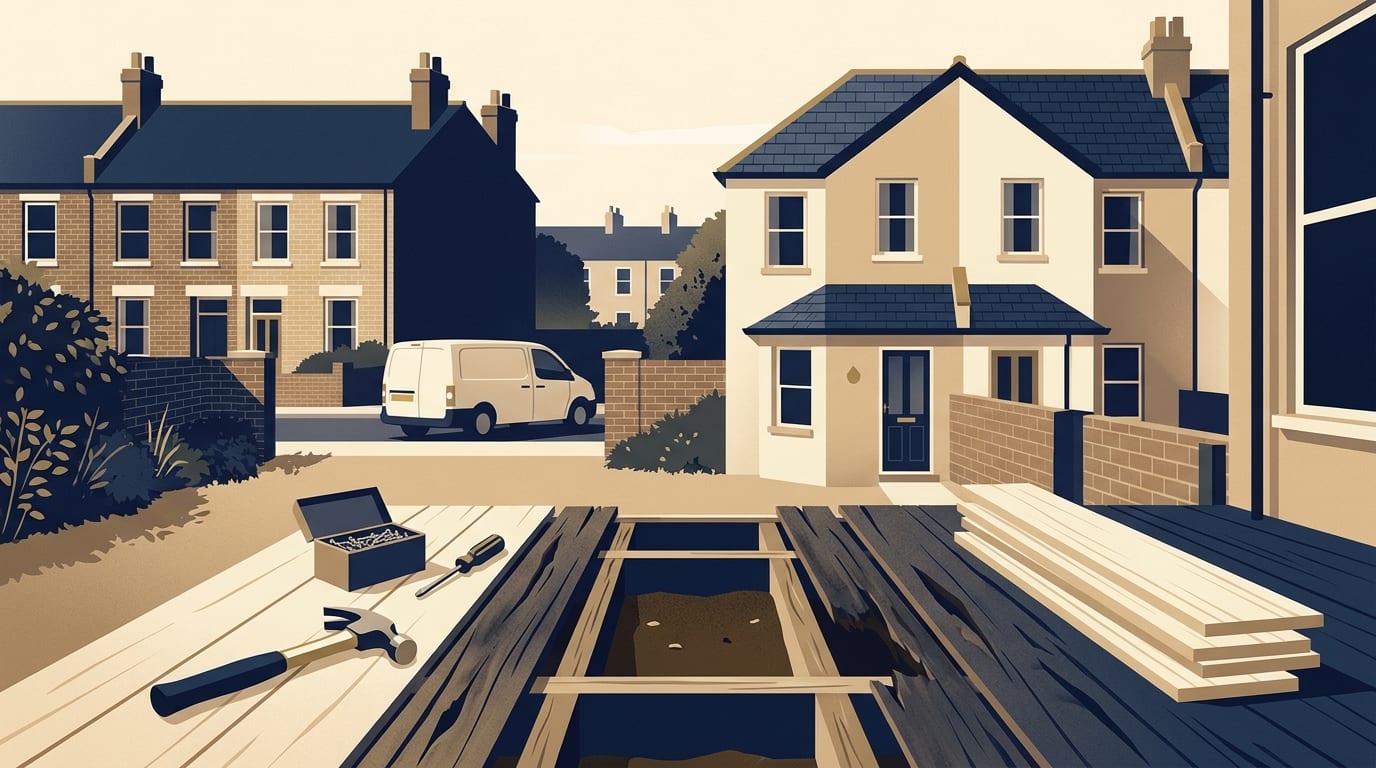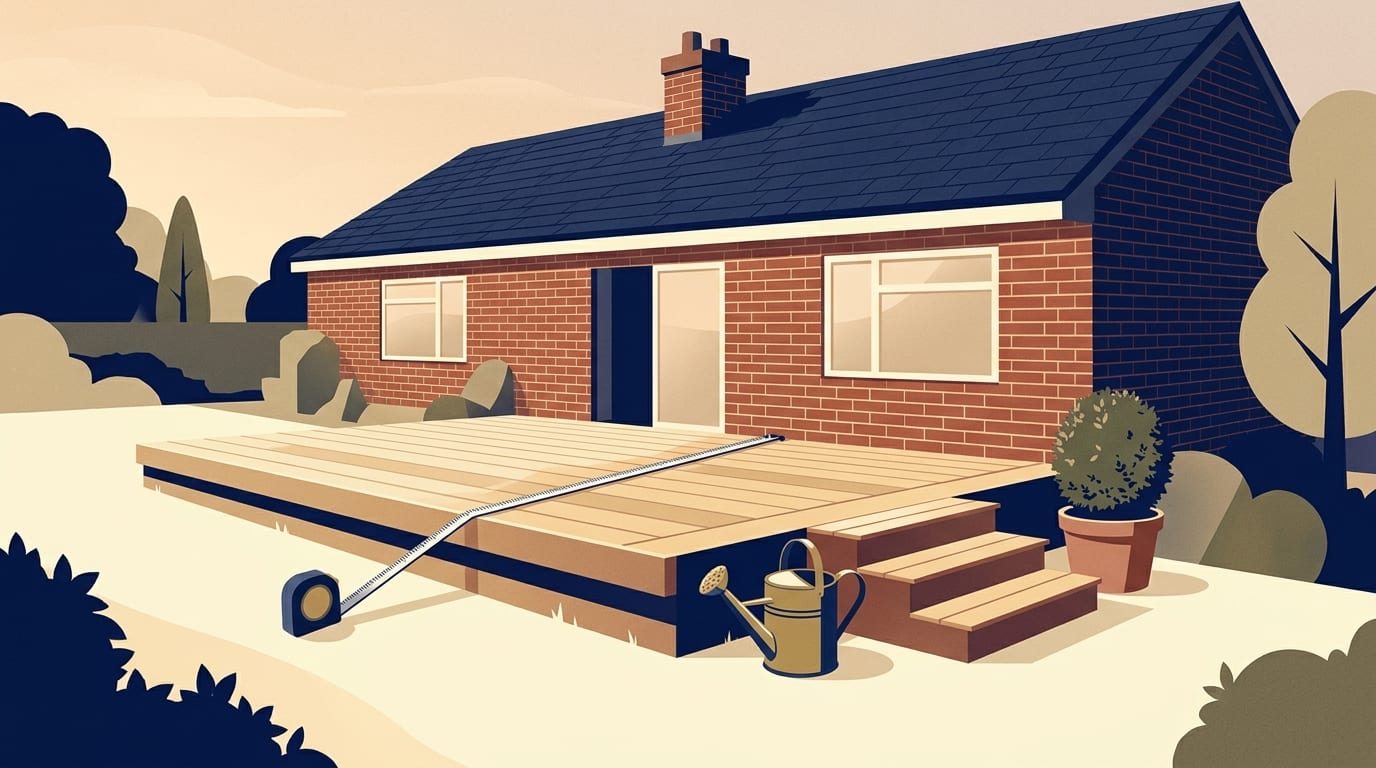
In England, putting up decking or a raised platform in your garden is permitted development, meaning you do not need planning permission if you meet certain conditions. The main rule is that your decking must be no more than 30cm above the ground. It must also cover no more than 50 per cent of your garden area when combined with other extensions and outbuildings. These rights apply to houses, but not to flats or maisonettes.
When you need planning permission for garden decking
Understanding the rules begins with knowing how the landscaping trade works. A garden designer produces the plan for your outdoor space, a landscaper or landscape contractor builds it, and a gardener maintains it. Hard landscaping is the built part of a garden, which includes patios, paths, walls, steps, fencing, drainage and decking. Soft landscaping is the living part, which covers the soil, turf, planting and trees.
Under the rules for England set out by the Planning Portal, putting up decking or other raised platforms in your garden is permitted development, subject to conditions. This means you have the right to build a deck without submitting a formal planning application, provided you stay within strict limits. These permitted development rights apply to houses. They do not apply to flats or maisonettes, so you must always check with your local council if you live in a shared building.
Understanding the 30cm height rule
The main condition for any raised platform is that it must sit no higher than 30cm above the ground. If any part of your deck exceeds this height, it no longer counts as permitted development. You will then need to apply for planning permission from your local planning authority.
A professional landscaper should check the proposed height during their initial site visit. If you want a raised deck to sit completely flush with your patio doors, you must measure the distance from the ground outside to the top of the finished deck boards. If that gap is more than 30cm, the deck is no longer permitted development. You should not start any groundwork until you know exactly how high the finished surface will be.
How much of your garden a deck can cover
The next condition relates to the overall size of your outdoor space. The decking or platforms, together with other extensions and outbuildings, must cover no more than 50 per cent of the garden area. Outbuildings include structures like sheds, greenhouses and garden rooms. Work out the total garden area to see how much space you have left.
If you have already built a large rear extension or a summerhouse, you have less of your original garden area available to use. A sprawling deck that takes up most of a small courtyard garden will likely break this 50 per cent limit. If your planned decking pushes the total covered area over the limit, you will need to submit a planning application.
Where decking cannot go
The location of your timber or composite structure is just as important as its size. Under permitted development rules, none of the decking or platform may be on land forward of a wall forming the principal elevation. The principal elevation is usually the front of the house facing the road. This rule prevents homeowners from building large structures in their front gardens without council oversight.
A deck at the front of your property is outside these permitted development rights, so check with your council before you plan one. To stay within the rights, keep all permitted development decking to the side or the rear of your house.
Rules for listed buildings and protected areas
Older and historically significant properties face much tighter restrictions for hard landscaping. Within the curtilage of a listed building, no decking or platform is permitted under these rights. The curtilage is the land and outbuildings belonging to the main property. If your house is listed, you must apply for formal consent before starting any decking project.
Extra limits also apply if you live in certain protected areas. In National Parks, the Broads, Areas of Outstanding Natural Beauty and World Heritage Sites, the rules change for large gardens. In these locations, the decking area more than 20 metres from the house is limited to 10 square metres. If you want a larger deck far away from the house in one of these protected areas, you will need planning permission.
Checking the rules in Scotland and Wales
The official guidance from the Planning Portal relates strictly to the planning regime for England. The policy in Wales may differ, and the page does not cover Scotland. If you live in Scotland, Wales or Northern Ireland, you must check with your local council to find out what rules apply to your garden.
The same advice applies if you live in a house where the council has altered the standard rules. Some homes have their permitted development rights removed. Checking directly with your local planning department is the only way to be absolutely certain before you spend money on materials.
Permitted development rules for decking
This table shows the main permitted development limits for building a deck in an English garden.
|
Planning rule |
Permitted development limit |
|---|---|
|
Height above the ground |
Maximum 30cm |
|
Total garden area covered |
Maximum 50 per cent |
|
Location restriction |
Not forward of the principal elevation |
|
Distance in protected areas |
Maximum 10 square metres if over 20m from house |
These limits apply to England. Your council has the final word on your own garden.
How to plan a deck on a sloping garden
Building a deck on a sloping or uneven garden requires careful measurement. Because the 30cm limit is measured from the ground, a deck that is perfectly level on a slope can easily exceed the height limit at the lower end. A landscape contractor must measure this drop accurately before they start work.
If the distance from the ground to the top of the deck exceeds 30cm at the low end, it is no longer permitted development, so check with your council. You might need to excavate the higher ground to keep the overall height down. Digging out soil increases the groundwork and waste removal costs, which will change the total garden decking cost for the project. A good landscaper will explain these options during their site visit.
How decking compares to paving rules
If you are deciding between a deck and a patio, the planning rules are slightly different. Paving more than 5 square metres of a front garden with an impermeable surface that does not drain to a permeable area needs planning permission. Permeable surfacing does not need permission because it allows water to drain naturally into the ground.
Hard landscaping like paving requires a solid sub-base, which is compacted crushed stone, often called MOT Type 1. Patios also need falls, which are the slight slopes built in to shed water away from the house. Decking does not have these specific front garden drainage rules, but decking forward of the principal elevation is outside permitted development rights. To compare the two options, read the guide on patio or decking.
Building regulations and safe construction
The official Planning Portal guidance does not set out building regulations rules. Building regulations are a separate system from planning, and a different set of rules can apply for building control.
You should find your local building control authority and check what they require before you start building. Do not assume that avoiding planning permission means you can ignore building regulations entirely.
How decking jobs are scoped and priced
Landscapers price per project after a site visit to inspect the garden. The main cost drivers are as follows.
- The total area of the decking and the complexity of the design.
- The groundwork required to level the site and prepare the ground.
- The changing levels across the garden that require extra steps or supports.
- The materials you choose for the frame and the surface boards.
- The access to the garden, as everything carried through the house costs more.
You will need to choose between softwood, hardwood and composite boards, as well as the timber or composite frame beneath them. A good quote will state the named materials clearly and explain the waste removal process. Any trader who carries waste must be a registered waste carrier, and the register is a public record you can check online.
Avoiding cowboy traders and poor workmanship
The groundwork nobody sees is where corners get cut in hard landscaping. A bad contractor might build a flimsy frame for decking or fail to secure it properly to the ground. You should watch out for several warning signs when looking for a landscaper.
- Doorstep callers offering cheap paving or leftover materials from another job.
- Traders asking for cash deals with no written specification or contract.
- Quotes that do not mention the depth of the sub-base or the excavation required.
- Artificial grass laid straight onto soil without proper preparation.
- Patio slabs laid on dabs of mortar instead of a full solid bed.
Without a written contract, you have very little protection if the boards warp or the frame rots. A patio with no fall will cause water to pool or run towards your house, creating damp problems that cost a lot to fix. Poor workmanship takes many forms, so you must always check a trader's past work.
What to ask your landscaper before work starts
Landscaping is not a licensed trade, so vetted membership and evidence of past work matter greatly. The British Association of Landscape Industries (BALI) says its Accredited members are vetted on workmanship, skill and health and safety. The Association of Professional Landscapers (APL) says members are assessed, regularly inspected and TrustMark accredited.
TrustMark is the government-endorsed quality scheme for tradespeople. Membership of these bodies is a good sign of a reliable business, but it is not a guarantee. You should ask your landscaper for a written quote, which is a fixed price, rather than an estimate, which is just a rough guess. Larger jobs are typically paid in stages, and you should always check whether VAT is included in the final price.
Common questions
Does composite decking need planning permission?
The permitted development rules apply to the structure itself, regardless of the materials you use. Whether you build the deck with softwood, hardwood or composite boards, the 30cm height limit and the 50 per cent garden rule still apply.
Do garden designers handle planning applications?
A garden designer produces the plan for your outdoor space, and the Society of Garden and Landscape Designers (SGLD) is their professional body. Some designers may help with the drawings for a planning application, so ask, and agree in writing who is responsible for submitting them to the council.
Do I need permission to put a deck near a tree?
A Tree Preservation Order makes it an offence to cut down, lop, uproot or damage a protected tree without the council's consent. Work on trees in a conservation area normally needs six weeks' notice to the council. If your decking groundwork might damage tree roots, you must check for preservation orders first.
Can fences be built around a new deck?
Fences and walls can be up to 1 metre high next to a road or its footpath and 2 metres elsewhere under permitted development. If you build a raised deck and add a fence on top of it, check the combined height with your council before you build.
Your next steps for a new garden deck
Before you hire a landscape contractor to build your deck, you should get your plans and paperwork in order.
- Measure your garden to ensure the deck and any outbuildings cover no more than 50 per cent of the area.
- Check the ground levels to see if a flat deck will sit more than 30cm above the soil at the lowest point.
- Contact your local council if you live in a flat, a listed building or a property in a protected area.
- Ask three different landscapers for written quotes that detail the frame materials, the boards and the waste removal.
- Check that the trader is a registered waste carrier and look for vetted membership of BALI or the APL.
Under the Consumer Rights Act 2015, all landscaping work must be done with reasonable care and skill. If it is not, you can ask for it to be put right or seek a partial or full refund. Citizens Advice suggests getting a written contract, keeping deposits to no more than 25 per cent, and paying by card for extra protection. They also note you might be able to cancel within 14 days of agreeing a contract, and you can contact them for disputes. When you know what size deck you want and whether you need permission, you can find a landscaper near you to discuss the project.
Find a top rated landscaper near you
4,373 landscapers across the UK, each ranked on their Google rating and the number of reviews behind it. Start with your county: