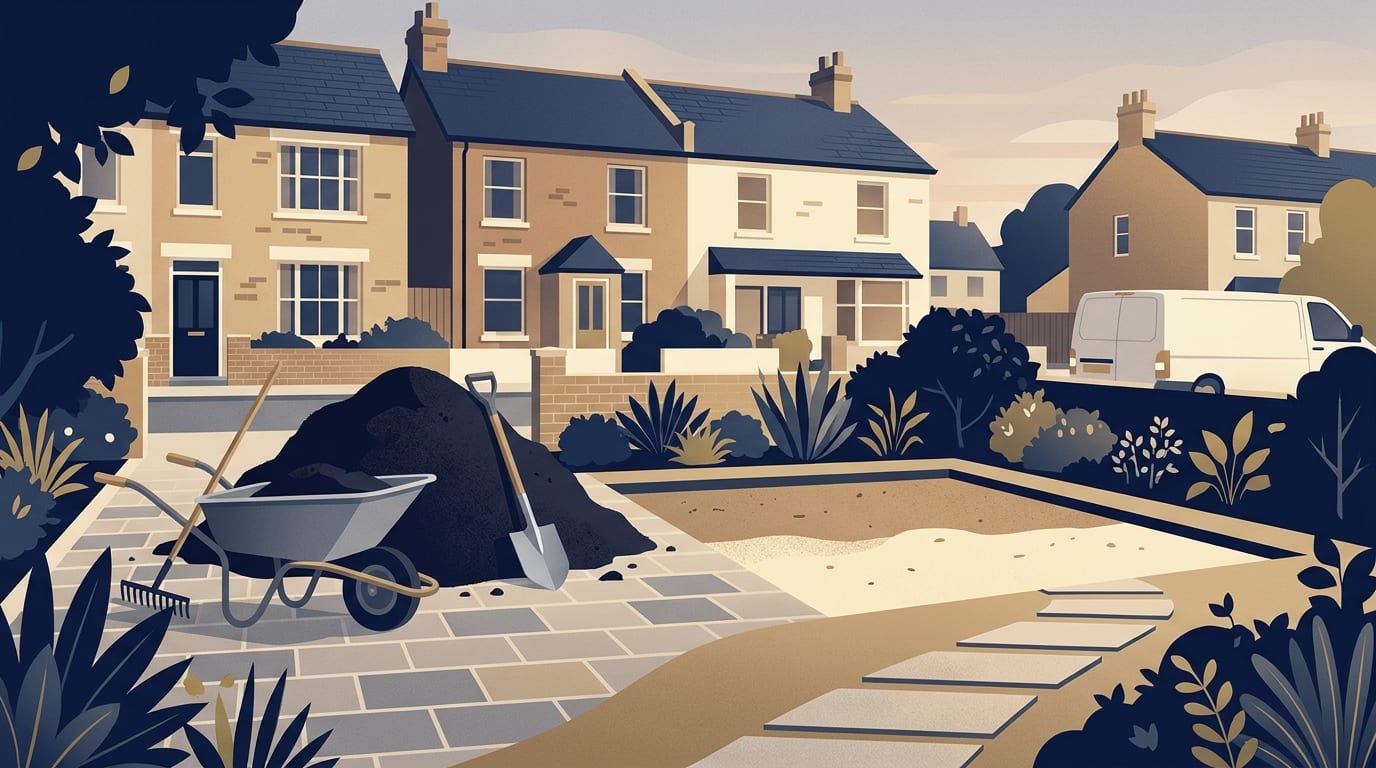
A new lawn needs a layer of at least 10cm of topsoil, and new garden beds require about 20cm or more. The volume you need is simply the area of your project multiplied by that depth. This guide explains how to calculate your exact volume, what British Standard grades mean, and what you should expect a landscaper to quote.
How much topsoil do you need for a garden project?
Grass and plants need a good foundation to thrive in your garden. If you are looking at how to landscape a new build garden with poor soil, you may need to bring fresh earth in. The Royal Horticultural Society says a new lawn needs a layer of at least 10cm of topsoil. Turf ideally needs around four inches of topsoil to root in properly.
For planting areas, you need a deeper layer. New beds will need about 20cm or more of fresh topsoil.
These depths are minimums, and if your existing ground is compacted clay or full of rubble, you might need to dig out more of the bad ground and replace it with a thicker layer of good earth.
How to work out the volume from area and depth
Topsoil is sold by volume or by weight, but you must calculate the volume first. You find this by multiplying the area of your project by the depth of earth you need. All your measurements must be in metres for the calculation to work.
For a standard garden lawn, a 50 square metre area multiplied by a depth of 0.1 metres equals a volume of about 5 cubic metres. You should only use this calculation to find your cubic metre figure, and you should measure carefully to avoid ordering too much.
Do not try to convert cubic metres into tonnes or bulk bags yourself. Earth varies in weight depending on how wet it is, so a fixed conversion would be unreliable.
Instead, take your cubic metre figure directly to your supplier or landscaper. Ask them whether they are pricing the job by the cubic metre or by the tonne. You should also ask them exactly how many bulk bags they will deliver to make up your required volume.
The landscaping trade and who does what
When you are planning a major garden overhaul, you need to hire the right professional for the right stage of the job. A garden designer produces the plan for your new outdoor space. The Society of Garden and Landscape Designers (SGLD, formerly the Society of Garden Designers) is the professional body for designers. Design fees are usually separate from the cost of the building work, and larger jobs are paid in stages.
A landscaper or landscape contractor builds the garden. They handle both hard and soft landscaping. Soft landscaping is the living part of the garden, which covers soil, turf, planting and trees. Hard landscaping is the built part of a garden, which includes patios, paths, walls, steps, decking, fencing and drainage. If you are adding decking, a landscaper will build the frame beneath the boards and can supply softwood, hardwood or composite boards.
A gardener maintains the garden once it is built. While a landscaper will bring in heavy machinery to dig out poor ground and spread cubic metres of fresh earth, a gardener will focus on pruning, mowing and keeping the new plants healthy.
If your project involves mature trees, you must be careful. A Tree Preservation Order makes it an offence to cut down, lop, uproot or damage a protected tree without the council's consent. Work on trees in a conservation area normally needs six weeks' notice to the council.
British Standard 3882 grades explained
Good topsoil should meet British Standard 3882:2007 and comes in three different grades. Knowing these grades helps you check what a quote is actually pricing.
Premium grade earth has a pH between 5.5 and 7.8. It has a minimum P index of 2, a K index of 2 and an Mg index of 1. Crucially, premium grade earth should not bring in weed seeds, which matters where weed seeds would be a problem.
General-purpose grade earth has a slightly wider pH range of 5.0 to 8.2 but shares the same minimum nutrient indices. It is screened to different sizes to suit different jobs. Coarser screens suit turf laying while finer screens suit top dressing.
Economy grade earth also has a pH of 5.0 to 8.2 but it has no minimum requirements for P, K or Mg. It is usually sold unscreened, which is often called as dug. This grade suits jobs where bulk matters more than quality. If you plan to level a sloping garden, ask the landscaper which grade they are pricing.
The table below shows the three British Standard grades and what they are best used for.
|
Grade |
RHS standard requirements |
Best used for |
|---|---|---|
|
Premium |
pH 5.5 to 7.8, minimum P index 2, K index 2, Mg index 1, weed seed free |
Where weed seeds must be avoided |
|
General-purpose |
pH 5.0 to 8.2, minimum P index 2, K index 2, Mg index 1 |
Turf laying (coarser) or top dressing (finer) |
|
Economy |
pH 5.0 to 8.2, no P, K or Mg requirements, unscreened |
Jobs where bulk matters more than quality |
These are the RHS figures for the three BS 3882:2007 grades.
What topsoil costs in 2026
When you are looking at how much turfing a garden costs, the earth beneath it can be a major expense. Typical 2026 prices put topsoil at £45 to £135 per cubic metre when poor ground needs it before laying. London and the South East cost more, and you should always check whether VAT is included in any price you are given.
The earth itself is only part of the bill. You also have to pay for the labour to prepare the ground and move the material. If the work is done by hand without a digger, you should allow around 60 minutes per square metre for hand preparation. For a large lawn, that labour time adds up very quickly.
A landscaper will remove the existing surface, dig to a suitable level, add fresh topsoil or improver, and let the ground settle before laying turf. Access heavily influences this cost, because everything carried through the house costs more.
Waste removal is another significant expense. If your landscaper is digging out heavy clay to make room for good earth, that waste must be taken away legally. A trader who carries waste must be a registered waste carrier, and the register is public.
The table below compares the typical costs of topsoil and digger hire.
|
Item |
Typical cost |
|---|---|
|
Topsoil per cubic metre |
£45 to £135 |
|
Digger hire (first day) |
From around £200 |
|
Digger hire (extra days) |
£50 to £75 per day |
These are typical 2026 guide figures, and local quotes will differ.
Checking the topsoil before it is spread
The Royal Horticultural Society says it is best to check topsoil before buying. Once a landscaper has spread 5 cubic metres of poor earth across your garden, it can be hard to remove it again.
You should look for physical signs that the earth is low quality or poorly screened.
- Excess stones.
- Thick fibrous roots.
- Weeds sprouting from the earth before it has even been spread.
- Contaminants such as glass and brick that suggest the earth came from a building site.
Ask where the earth comes from and whether the whole load comes from the same place. Earth taken from building sites can give variable quality. If the supplier has a soil analysis, ask for a written copy and compare it with the grade criteria.
Imported topsoil can bring in invasive species such as Japanese knotweed and couch grass. A landscaper should inspect every load before it is spread.
What a quote should state and who supplies the earth
You can order earth yourself for bulk delivery or ask your landscaper to supply it. If a landscaper supplies it, ask them to state the grade and where it comes from in the quote. If you buy it yourself, you will need to do those checks yourself.
A quote is a fixed price, whereas an estimate is a rough guess. A professional quote should state exactly what materials are being used and how they will be handled.
- The exact British Standard 3882:2007 grade of the earth being supplied.
- The depth the earth will be laid at across the whole garden.
- The total volume in cubic metres required for the project.
- Whether delivery is included in the final price.
- Who is responsible for moving, spreading and levelling the earth on site.
The groundwork nobody sees is where corners get cut. A detailed written specification helps you compare quotes fairly. Alongside the topsoil details, a good quote for hard landscaping states the excavation depth, named materials, drainage and waste removal. It should detail the sub-base, which is the compacted crushed stone, often called MOT Type 1, used under paving and artificial grass. It should also state the falls, which is the slight slope that sheds water.
Doorstep callers offering cheap paving or leftover materials are a major warning sign, as are cash deals with no written specification. Common problems include a thin or missing sub-base, slabs laid on dabs of mortar instead of a full bed, and no fall so water pools or runs towards the house. Another frequent mistake is artificial grass laid straight onto soil.
Landscaping is not a licensed trade, so vetted membership and evidence of past work matter. The British Association of Landscape Industries (BALI) says its Accredited members are vetted on workmanship, skill and health and safety. The Association of Professional Landscapers (APL) says members are assessed, regularly inspected and TrustMark accredited. TrustMark is the government-endorsed quality scheme. Membership is a good sign, not a guarantee.
Under the Consumer Rights Act 2015 work must be done with reasonable care and skill. If not, the customer can ask for it to be put right or seek a partial or full refund. Citizens Advice suggests getting three written quotes, a written contract, paying deposits of no more than 25 per cent and paying by card. They also say you might be able to cancel within 14 days of agreeing a contract. If you have a dispute with a trader, you should contact Citizens Advice.
Common questions
Does topsoil settle after it is laid?
Ground needs time to settle. A landscaper will remove the existing surface, dig to a suitable level, add fresh topsoil or improver, and let the ground settle before laying turf. Laying turf straight onto loose ground risks uneven settling.
Do I need a digger to move topsoil?
Hand preparation takes around 60 minutes per square metre without a digger. Digger hire is from around £200 for the first day, then £50 to £75 per extra day. Ask your landscaper whether a digger is included in the price.
What happens if I lay turf on poor ground?
Turf ideally needs around four inches of topsoil to root in. Turf laid on poor or shallow ground may not root well, which is why a quote should state the depth of topsoil.
Why are building site soils risky?
Earth from building sites can give variable quality because building sites can give variable quality. It can also contain contaminants like glass and brick, or invasive weeds like Japanese knotweed and couch grass. Always ask for a written soil analysis and check the earth before it is spread.
Next steps before you order
Before you agree to a quote or order bulk bags of earth, you should follow these final steps to protect your budget and ensure you get the right materials.
- Measure your garden area in metres and multiply it by your required depth to find the volume.
- Decide which grade suits the job. Premium topsoil should not bring in weed seeds, coarser general-purpose grades suit laying turf, and economy grades suit jobs where bulk matters more than quality.
- Ask your supplier whether they price by the cubic metre or by the tonne, and how many bulk bags that equals.
- Get three written quotes from landscapers that state the grade, depth and volume of the earth.
- Check that your chosen landscaper is a registered waste carrier if they are removing old soil.
- Agree a deposit of no more than 25 per cent, as Citizens Advice suggests, and plan to pay by card.
If you are ready to start planning your new lawn or garden borders, you can find a landscaper near you to discuss your ground preparation and get a detailed written quote.
Find a top rated landscaper near you
4,373 landscapers across the UK, each ranked on their Google rating and the number of reviews behind it. Start with your county: