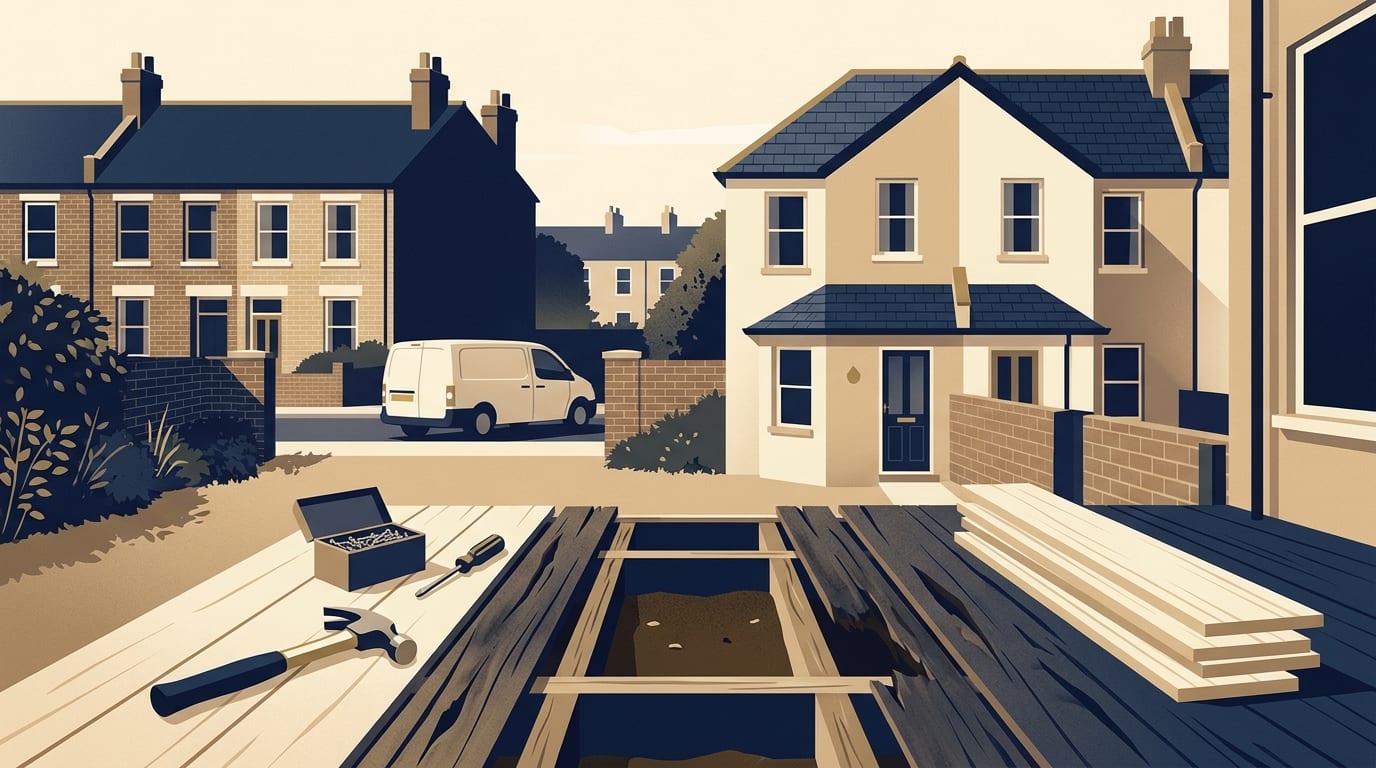
Surface boards are cheap to swap out, but rot in the frame underneath changes the answer completely. You need to find out which part has failed first. A deck with a sound frame can be patched up for a few hundred pounds. Once the structural timber softens and rots, you are usually looking at a full replacement.
What rotten decking looks like
Timber decks show their age on the surface first. You will often see moss and algae building up on the boards, which keeps the wood damp and accelerates decay. The stain or oil treatment wears away, leaving the timber grey and exposed to the rain. Eventually, the boards begin to warp, splinter and crack underfoot.
The real test of a deck is how it feels when you walk on it. Boards that bounce or feel spongy are a clear sign that the wood has lost its strength. Fixings that no longer hold, with screws popping up or boards coming loose, are a warning that the timber around the screw thread has rotted away.
You can check the extent of the damage using a simple screwdriver probe. Press the tip of a screwdriver into the timber boards and the supports below them. Firm resistance means the wood is still solid and holding its internal structure. If the screwdriver sinks easily into soft, spongy wood, that section of timber has failed and needs to be removed.
Boards or frame and the question that decides everything
A garden deck is built in two distinct parts. The visible part is the surface boards, which take the foot traffic and the weather. Beneath them sits the subframe, which is the entire supporting structure that takes the weight and keeps the deck level. The subframe is made up of posts set into the ground and joists, which are the horizontal timber lengths the boards sit directly on.
Surface boards dry out relatively quickly after rain. The joists underneath do not get the same sunlight or airflow, so they stay damp for longer. Water runs down through the gaps in the boards and sits on top of the joists, which is where rot usually takes hold first. Soft, spongy framing in several places means the deck is near the end of its life.
Rot in the joists is the expensive discovery. If you find that the joists or supporting posts are soft, the deck should not be used until a professional has looked at it. You should never attempt a structural fix on a raised deck yourself, as working at height with compromised timber is dangerous. A landscaper or carpenter should assess any raised deck to see if the structure is still safe to stand on.
Why UK decks rot
Timber left outside in the UK will eventually rot if it stays wet. Moisture is the primary cause of decking failure, especially where water is trapped against house walls or underneath heavy planters. A deck needs airflow beneath it to dry out the structural timbers after a downpour.
Poor ground preparation also traps water under the timber. Good landscaping relies on proper drainage beneath the surface. This often involves laying a sub-base, which is compacted crushed stone, often called MOT Type 1, used under paving and artificial grass. While a deck sits above the ground, the soil below still needs falls, which is the slight slope that sheds water away from the house.
You also need to understand permeable versus impermeable surfaces. A timber deck is a permeable surface because water drains through the gaps. If the ground below is an impermeable surface like heavy clay with no slope, water will pool around the timber posts and rot them from the bottom up.
Common causes of rot include:
- Moisture trapped against house walls or underneath heavy planters.
- Subframes built without proper drainage.
- Boards not treated yearly, leading to wet rot and dry rot.
- Moss and algae left on the boards to trap water.
- Fixings that no longer hold, allowing water into the screw holes.
When repairing makes sense
Firm framing with worn boards is entirely repairable. If your screwdriver test shows that the joists are solid, you can safely lift the damaged surface boards and screw down new ones. Boards can often be replaced on a sound frame for much less than a full rebuild.
Tradespeople offer different rules of thumb for deciding when to stop patching. The general consensus is that replacement makes more sense if more than about 20 to 30 per cent of the boards have failed. Below this threshold, swapping out a few rotten lengths of timber is a quick and cost-effective job.
Patching a deck works best when the damage is localised. A leaking gutter might have rotted one corner, or a heavy plant pot might have ruined a single board. You can cut out the damaged section, treat the exposed cuts with wood preservative, and drop in a replacement board. The new timber will look brighter than the old wood at first, but it will weather down to match over a few months.
When to replace the deck
Once joist rot spreads to several locations, replacement or a completely new build is better than patching piece by piece. Fixing new boards to rotting joists is a waste of money, as the screws will simply pull out of the soft wood. The structural integrity of the whole deck relies on the frame beneath it.
There is no official threshold for a total replacement, but tradespeople generally advise replacing the whole deck if more than a third of the boards need replacing or the subframe is soft. Rot in the posts or joists means the core structure has failed. At this point, the deck is beyond a sensible repair and needs to be taken down.
A deck that feels unsafe, leans to one side, or bounces heavily when you walk on it has usually suffered extensive structural rot. Leaving a failing deck in place invites pests and creates a trip hazard in your garden. Tearing it down gives you a blank canvas to correct any drainage issues in the ground below before you build anything new.
Typical repair costs in 2026
Landscapers price per project after a site visit, and the amount you pay will depend on the size of your deck and the access to your garden. Access is a major factor, as everything carried through the house costs more in time and labour. The table below shows typical costs to repair a standard 15 to 25 square metre softwood garden deck.
|
Type of repair |
Typical cost |
|---|---|
|
Replace damaged boards |
£100 to £300 |
|
Re-fix loose boards and rails |
£80 to £200 |
|
Joist or structural repair |
£300 to £900 |
|
Sand and re-oil or re-stain |
£150 to £400 |
|
Full refurbishment |
£500 to £1,500 |
These figures are typical 2026 prices, and your local quotes will differ. You should always check whether your quote includes VAT.
Replacing damaged boards usually breaks down to £10 to £30 per board, while sanding and re-oiling works out at £8 to £15 per square metre. For a smaller 4-metre by 3-metre deck with a few rotten boards and one rotten joist, tradespeople estimate a repair will cost about £300 to £700.
Replacement and what to choose next time
If your deck is beyond repair, a full replacement costs around £1,500 to £3,000 depending on the materials you choose. You will need to decide between softwood boards, hardwood boards, and composite boards, as well as the frame beneath them. Each material has a different expected lifespan, though tradespeople's opinions on exactly how long they last vary widely.
Pressure-treated softwood is the cheapest option, and tradespeople suggest it lasts 10 to 20 years. Hardwood is much denser, naturally resistant to rot, and generally lasts 20 to 40 years or more. Composite decking is made from a mix of wood fibres and plastic. Tradespeople estimate composite lasts anywhere from 15 to 50 years, as it does not rot like natural timber.
You can build a new deck using composite boards on a timber frame, provided the frame is entirely sound and protected from standing water. Many homeowners use a replacement as a chance to upgrade their materials. You can read more about weighing up composite against timber boards, and see how the materials compare for typical garden decking costs.
General trade opinion puts the lifespan of a standard timber deck at 7 to 25 years. The huge gap in those numbers comes down to how well the deck was built in the first place, and how often the owners treated the wood.
Keeping a repaired deck going
Regular maintenance extends the life of any timber deck significantly. Tradespeople agree that regular oiling is the difference between a deck lasting about 10 years and one lasting about 25 years. You should aim to re-oil softwood every two to three years to keep the timber fed and water-resistant.
Before you apply any oil or stain, the deck must be completely clean and dry. Sweep away all leaves and dirt, and use a stiff brush or a pressure washer on a low setting to remove moss and algae. If you trap moisture under a new layer of oil, the wood will simply rot from the inside out.
Keep the gaps between the boards clear of debris. Leaves and dirt build up in these gaps over the winter, blocking the drainage and holding wet mulch against the joists. Running a stiff brush down the gaps once a year allows rainwater to flow freely through the deck and away into the ground.
How the landscaping trade works
Before you hire someone to repair or replace your decking, it helps to understand who does what in the garden. Hard landscaping is the built part of a garden, including patios, paths, walls, steps, decking, fencing and drainage. Soft landscaping is the living part, such as soil, turf, planting and trees. A garden designer produces the plan, a landscaper or landscape contractor builds it, and a gardener maintains it.
Landscaping is not a licensed trade, so anyone can offer to build a deck. Vetted membership and evidence of past work matter heavily. The British Association of Landscape Industries (BALI) says its Accredited members are vetted on workmanship, skill and health and safety. The Association of Professional Landscapers (APL) says members are assessed, regularly inspected and TrustMark accredited. TrustMark is the government-endorsed quality scheme.
If you are planning a wider garden redesign, the Society of Garden and Landscape Designers (SGLD) is the professional body for designers. Membership of any of these bodies is a good sign, not a guarantee, but it proves the trader has passed an external assessment.
The groundwork nobody sees is where corners get cut. A bad landscaper might leave you with a thin or missing sub-base, slabs laid on dabs of mortar instead of a full bed, or no fall so water pools or runs towards the house. A good written quote will specify the unseen groundwork to prove they are not cutting corners, including:
- The excavation depth and the sub-base depth.
- The named materials to be used for the frame and boards.
- The drainage plan to ensure water flows away from the house.
- A clear plan for waste removal.
A trader who carries waste must be a registered waste carrier, and the register is public. Never accept a cash deal with no written specification, and avoid doorstep callers offering cheap paving or leftover materials.
Rules and consumer protections
Most garden decking does not require formal permission, but strict rules apply. Decking is permitted development if it is no more than 30cm above the ground and, together with extensions and outbuildings, covers no more than 50 per cent of the garden. These rights apply to houses, not flats or maisonettes, and listed buildings need consent for significant work.
If you are replacing fences or paving at the same time, fences and walls can be up to 1 metre high next to a road or its footpath and 2 metres elsewhere. Paving more than 5 square metres of a front garden with an impermeable surface that does not drain to a permeable area needs planning permission. Permeable surfacing does not. These rules apply in England per the Planning Portal. Elsewhere, or if unsure, you should check with your council.
Be careful working near mature trees. A Tree Preservation Order makes it an offence to cut down, lop, uproot or damage a protected tree without the council's consent. Work on trees in a conservation area normally needs six weeks' notice to the council.
Under the Consumer Rights Act 2015, work must be done with reasonable care and skill. If not, the customer can ask for it to be put right or seek a partial or full refund. A quote is a fixed price, while an estimate is just a rough guess. Citizens Advice suggests getting three written quotes, a written contract, paying deposits of no more than 25 per cent and paying by card. They also note you might be able to cancel within 14 days of agreeing a contract.
Common questions
Can I lay artificial grass over rotten decking?
You should never lay artificial grass straight onto soil or over rotting timber. The artificial turf will trap moisture against the wood, speeding up the rot, and the whole surface will eventually collapse as the joists fail underneath.
Can I just replace the surface boards?
You can replace the surface boards only if the frame beneath them is completely sound. If the joists are soft or spongy, new screws will not hold, and the new boards will soon come loose.
How long will a repaired deck last?
This depends entirely on the condition of the subframe and how well you maintain the timber. Regular oiling every two to three years can push a softwood deck's lifespan up to 25 years, while a neglected deck might only last 10 years.
Why is my decking rotting so quickly?
Moisture is the main cause of rapid rot. Subframes without proper drainage, heavy planters sitting directly on the boards, and moss left uncleaned all trap water against the timber and prevent it from drying out.
Next steps for your decking
Before you start tearing up boards, take a methodical approach to checking the damage.
- Clear the deck completely of all pots, furniture and debris so you can see the surface.
- Use a screwdriver to probe the surface boards, the joists and the support posts for soft spots.
- Count how many boards are damaged to see if you are above or below the one-third replacement threshold.
- Ask three local landscapers or carpenters to assess the frame and provide written quotes.
- Check the government register to ensure your chosen tradesperson is a registered waste carrier.
A rotting deck does not always mean starting from scratch, but catching the damage early saves the expensive structural timber beneath. If your frame has failed and you need a professional to rebuild it safely, you can find a landscaper near you to assess the site and quote for the work.
Find a top rated landscaper near you
4,373 landscapers across the UK, each ranked on their Google rating and the number of reviews behind it. Start with your county: