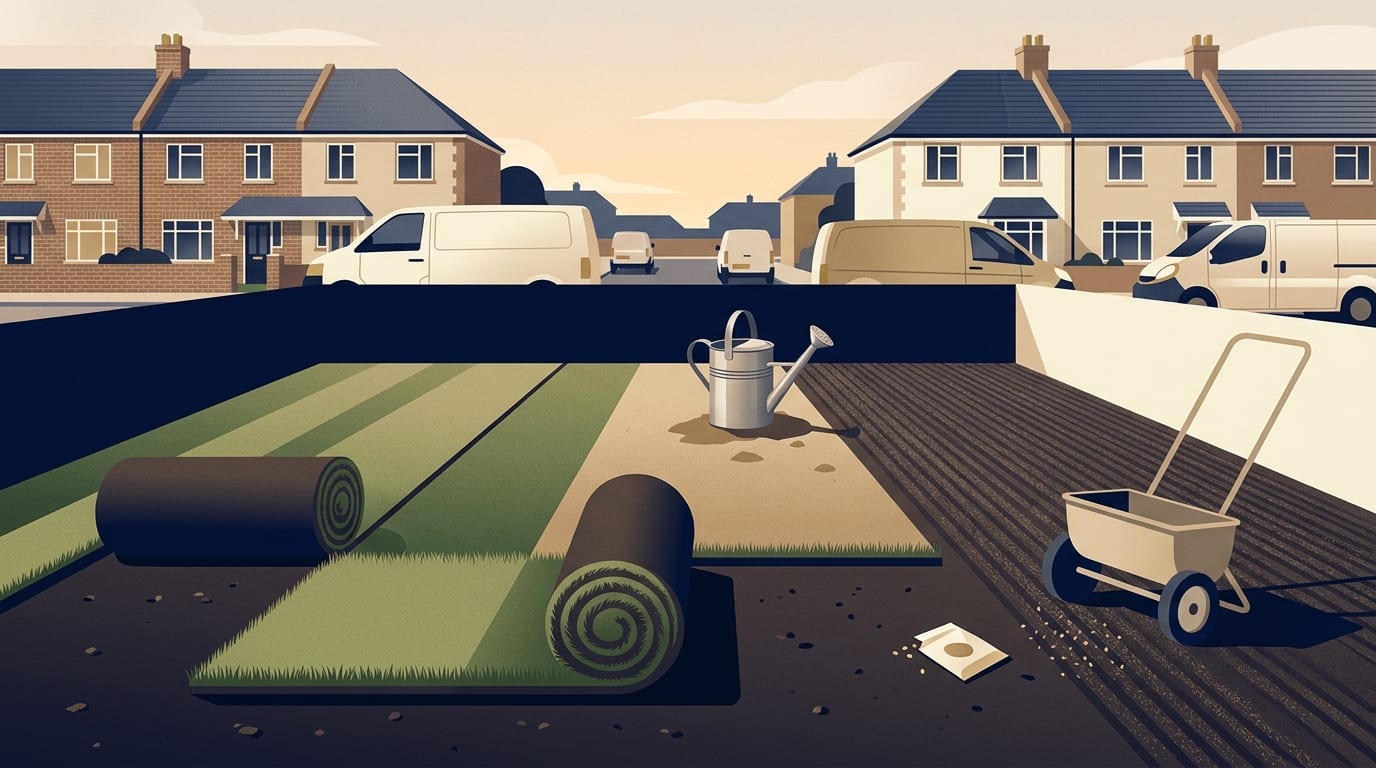
Grass seed is less expensive but takes a little longer to establish into a robust lawn. Turf gives you an instant lawn that you can use a few weeks after laying, but it costs more and must be laid soon after delivery. Choosing between them depends on your budget, your patience and how quickly you want to use the garden.
Grass seed or turf at a glance
Creating a new lawn falls under soft landscaping, which is the living part of a garden that includes soil, turf, planting and trees. Hard landscaping is the built part of the garden, covering features such as patios, paths, walls, steps, decking, fencing and drainage. Before you hire a professional for the soft landscaping, it helps to see how the two main lawn options compare.
This table compares the main differences between sowing a lawn and laying turf.
|
Feature |
Grass seed |
Turf |
|---|---|---|
|
Cost |
Less expensive |
More expensive |
|
Speed of results |
Seedlings in a week to ten days |
Instant lawn |
|
Best time to start |
Early autumn preferred |
Mid-autumn |
|
Storage |
Can wait for suitable weather |
Lay within 24 hours |
|
First use |
Use as little as possible for about eight months |
Stay off for roughly two weeks |
|
First mow |
Two or three days after rolling at 5 to 7.5cm tall |
After about three weeks |
These are RHS guidelines, and your exact timings will depend on the weather and the season.
Cost of grass seed against turf
Grass seed is less expensive than turf. Because there is no fixed seed rate per square metre given in general guidelines, you will need to check the packet to see how much area a box will cover. Turf is priced by the square metre, and the cost depends on the grade of the grass and whether you lay it yourself.
This table shows the typical cost of turf and professional installation.
|
Turf grade |
Supply only per square metre |
Fully installed per square metre |
|---|---|---|
|
Budget |
£2.40 |
£11 |
|
Standard |
£3.50 |
£13 |
|
Luxury |
£4.70 |
£15 |
These are typical 2026 guide prices, and local quotes will differ. Delivery from online turf specialists adds a further £1 to £2.50 per square metre, and you should always check whether your quotes include VAT. You can read more about how much turfing a garden costs if you want to compare local rates.
Landscapers price per project after a site visit. The main cost drivers are the area, the groundwork, the levels and the access. Anything that has to be carried through the house costs more in time and labour. Waste removal also pushes the price up, especially if you have an old lawn or heavy soil to clear.
Prices in London and the South East cost more than in other parts of the UK. For larger jobs, you will usually be asked to pay in stages as the work progresses.
How long each takes before you can use the lawn
When you sow grass seed, seedlings normally appear a week to ten days after sowing. You can roll the new lawn when the seedlings are 5 to 7.5cm tall to encourage strong growth. You must then wait two or three days before the first cut, and you should remove only about one third of the grass height when you mow.
A seeded lawn requires patience, and you must use the lawn as little as possible for about eight months. If you sow the seed in autumn, you should avoid using the lawn entirely before June.
Turf gives you an instant lawn in appearance, but it takes about three weeks to root properly into the soil. You must stay off the grass for roughly the first two weeks so the roots can take hold without being disturbed. You can then mow the lawn with the blades set high once the turf has rooted well, which is usually about three weeks after laying.
If you need a surface you can walk on immediately and you cannot wait for the roots to establish, you might consider artificial grass or real turf to see which fits your daily routine.
The best time to sow or lay
The best time to sow grass seed is in autumn, between September and November, or in mid-spring, between March and April. Early autumn is preferred because the seedlings have time to establish before the first hard frosts arrive. If the weather turns bad, grass seed can wait safely in its packet for suitable weather.
Turf is best laid in mid-autumn. It can be laid right through until early spring, provided the soil is not wet or frosty.
Unlike seed, turf deteriorates if it is not laid soon after delivery. It should be laid within 24 hours if possible, so plan the delivery for a day when you can lay it. You can find more detail on the best time to lay turf to help you plan the work around the UK seasons.
Preparing the ground for either
The groundwork nobody sees is where corners get cut, so proper preparation is vital for both seed and turf. For seed, the RHS says to start several weeks before sowing. The first step is to remove perennial weeds such as couch grass and bindweed.
For grass seed, compacted soil must be dug to about 20cm. You must then leave the dug soil to settle, ideally for five to six weeks. Once it has settled, you firm the soil and rake it to a fine, level seedbed.
For turf, the soil should be dug or rotovated to a depth of 20 to 25cm. Hand preparation without a digger takes around 60 minutes per square metre. This heavy manual labour is a major part of the groundwork, and it explains why professional quotes are much higher than the basic supply cost of the materials.
A trader who carries waste away from your garden must be a registered waste carrier. The register is public, so you can check their credentials to ensure your old soil and weeds are disposed of legally.
Aftercare in the first weeks
Once the lawn is down, aftercare matters. Keep new turf damp for the first couple of weeks, watering it daily in hot weather. During dry periods in mid to late summer, you should water it every five to ten days. At other times of the year, you should water it every fortnight during dry spells.
Seed gives you more flexibility before the lawn goes down, because seed can wait for suitable weather while turf cannot. Check the seed packet and ask your landscaper for sowing and watering advice.
Combining your lawn with hard landscaping
Many homeowners install a new lawn alongside hard landscaping features like a patio or decking. If your landscaper is building a patio next to the grass, they must install a proper sub-base. This is a layer of compacted crushed stone, often called MOT Type 1, which sits under paving and artificial grass to provide a stable foundation.
A patio also needs falls, which is the slight slope that sheds water away from the house and prevents puddles from forming on the slabs. You must choose between permeable surfaces, which allow rain to soak through into the ground, and impermeable surfaces, which block water and require separate drainage.
If you are adding decking next to the lawn, you need to distinguish between the different materials. You can choose softwood, hardwood or composite boards, and the landscaper must build a sturdy timber or composite frame beneath them to support the weight.
Planning rules for wider garden landscaping
If your new lawn is part of a larger garden redesign, you need to consider planning rules for the hard landscaping. In England, paving more than 5 square metres of a front garden with an impermeable surface that does not drain to a permeable area needs planning permission. Permeable surfacing does not require permission. These rights apply to houses, not flats or maisonettes, and listed buildings need consent for significant work.
In England, decking is permitted development if it is no more than 30cm above the ground and, together with extensions and outbuildings, covers no more than 50 per cent of the garden. Fences and walls can be up to 1 metre high next to a road or its footpath and 2 metres elsewhere.
If your landscaping involves trees, a Tree Preservation Order makes it an offence to cut down, lop, uproot or damage a protected tree without the council's consent. Work on trees in a conservation area normally needs six weeks' notice to the council. The planning rules above are for England, per the Planning Portal. If you live elsewhere in the UK, or are unsure, check with your local council.
What goes wrong with landscaping projects
When hiring someone to lay a lawn, you should watch out for bad practices across the whole landscaping project. Understanding these pitfalls helps you spot a bad quote before the work begins.
- Doorstep callers offering cheap paving or leftover materials from a nearby job.
- Cash deals with no written specification or proof of what was agreed.
- A thin or missing sub-base beneath patios or artificial grass.
- Slabs laid on dabs of mortar instead of a full bed.
- No fall on a patio, meaning water pools or runs towards the house.
- Artificial grass laid straight onto soil without a compacted crushed stone foundation.
Poor groundwork is a common problem for real lawns too. If a landscaper leaves out the settling time for a seeded lawn, the ground may sink unevenly. If they lay turf on poorly prepared soil, the roots may struggle to take hold.
Which suits your garden and your quote
Landscaping is not a licensed trade, so vetted membership and evidence of past work matter greatly. The British Association of Landscape Industries (BALI) says its Accredited members are vetted on workmanship, skill and health and safety. The Association of Professional Landscapers (APL) says members are assessed, regularly inspected and TrustMark accredited. TrustMark is the government-endorsed quality scheme. Membership is a good sign, not a guarantee.
A quote is a fixed price for the work, whereas an estimate is just a rough guess. Citizens Advice suggests getting three written quotes, signing a written contract, and paying deposits of no more than 25 per cent. They also recommend paying by card, and note that you might be able to cancel within 14 days of agreeing a contract.
A good written quote for a new lawn should include specific details.
- The exact seed mix or turf grade the landscaper will supply.
- The depth of topsoil that will be excavated, added or replaced.
- The method of digging, levelling and preparing the ground.
- The cost of waste removal for the old lawn, soil and weeds.
- The watering and aftercare instructions for the first few weeks.
- The expected start month and how long the job will take.
Under the Consumer Rights Act 2015, work must be done with reasonable care and skill. If the lawn fails because of poor preparation or incorrect laying techniques, you can ask for it to be put right or seek a partial or full refund. You should always document any problems with photographs as soon as they appear. If you encounter disputes that you cannot resolve with the landscaper directly, you should point your questions to Citizens Advice.
Common questions
Is turf or grass seed better for a quick result?
Turf gives you an instant lawn that looks finished on the day it is laid. You only need to stay off the grass for roughly two weeks while it roots. A seeded lawn requires much more patience, as you should use it as little as possible for about eight months.
Is grass seed cheaper than turf?
Grass seed is less expensive to buy than rolls of turf. However, both methods need groundwork, including digging the soil to about 20cm for seed or 20 to 25cm for turf, removing weeds and levelling the surface. This preparation makes up part of a landscaper's quote.
Which is safer to buy in unpredictable weather?
Grass seed can wait in its packet for suitable weather if conditions turn too wet or cold. Turf deteriorates quickly and should be laid within 24 hours of delivery. If the weather stops you laying it soon after delivery, it can be wasted.
Do I need a garden designer, a landscaper or a gardener for a new lawn?
A garden designer produces the plan for the outdoor space, choosing the layout, the planting scheme and the materials. A landscaper or landscape contractor builds it and carries out the heavy groundwork, such as digging the soil and laying the turf. A gardener maintains the lawn once it is established, handling the regular mowing, feeding and weeding. For a straightforward lawn replacement, you generally need a landscaper rather than a designer. The Society of Garden and Landscape Designers (SGLD, formerly the Society of Garden Designers) is the professional body for designers if you are planning a larger redesign.
Next steps before you decide
Before you choose between seed and turf, you should gather your measurements and speak to local professionals.
- Measure your garden to find the total area in square metres.
- Decide whether you can use the lawn as little as possible for about eight months for seed or stay off it for roughly two weeks for turf.
- Ask three different landscapers to visit your garden and provide a written quote.
- Check that each quote clearly states the excavation depth and waste removal costs.
- Look for evidence of past work and check for vetted membership of BALI or the APL.
- Ensure the trader is a registered waste carrier if they are removing old soil.
- Agree a deposit of no more than 25 per cent and plan to pay by card.
Comparing the preparation, costs and growing times helps you choose the right approach for your new lawn. When you are ready to start planning the groundwork, you can find a landscaper near you to discuss the best options for your soil and budget.
Find a top rated landscaper near you
4,373 landscapers across the UK, each ranked on their Google rating and the number of reviews behind it. Start with your county: